• Skip to primary navigation
  • Skip to main content
  • Skip to footer
Menu
  • Book a Space
  • Book a Tour
  • Locations
  • Memberships
    • Private Offices
    • Day Passes
    • Conference Rooms
    • Dedicated Desk
    • Coworking
  • Meeting Rooms
    • Austin
    • New York
    • Philadelphia
  • Student Login
  • Book a Tour
  • Book a Space
  • Book a Tour
  • Locations
  • Memberships
    • Private Offices
    • Day Passes
    • Conference Rooms
    • Dedicated Desk
    • Coworking
  • Meeting Rooms
    • Austin
    • New York
    • Philadelphia
  • Student Login
  • Book a Tour
  • Book a Space
  • Book a Tour

admin

The 10 Best Startup Ideas For 2021 And How To Get Started

white mug stamped with the word "begin" on wooden table

By Gregg Jackowitz, Managing Director, Bond Collective

Want to start your own business in 2020 but not sure what industry to investigate? Consider one of the startup ideas in this article as a good avenue for success in the coming years.

These businesses don’t require extensive experience or excessive capital to get going. And many of them have the potential to be profitable right out of the gate and continue so even through dips in the market. That makes them wise choices for the best startup ideas for 2020.

The 10 Best Startup Ideas For 2019

1) Social Media Management

If you’re familiar with the ins and outs of connecting with people via Facebook, Twitter, Instagram, and Pinterest, social media management may be the niche for you.

social media applications on mobile phone

Businesses large and small want to reach these audiences, and they’re willing to pay handsomely if you can boost leads, drive traffic to their website, and generate sales.

2) Fulfillment By Amazon Sales

Fulfillment By Amazon (or FBA for short) allows startups just like yours to sell their products in partnership with the largest online retailer on the planet. Amazon coordinates the storage, packing, shipping, returns, and customer service.

All you have to do is ship your products to Amazon, create a website listing, and pay a fulfillment and monthly storage fee. It’s a great way to get your product in front of millions of shoppers around the world.

3) Domain-Name Purchase And Sale

Buying and selling domain names and complete websites is rapidly moving toward the top of the list of the best startup ideas for 2020.

Domain names are cheap to buy (in the neighborhood of $15 dollars depending on several factors), but if you choose the right one, you can turn around and auction it off for hundreds, if not thousands, of dollars.

4) Software Development

As a startup idea, software development is still a strong contender. If you have some coding skills or are familiar with networking, security, or hardware/software repair, this niche might be right for you.

Even if you don’t have an idea for an app or other product, you can leverage your skills to help other businesses build theirs.

5) Curated Box Service

If you have a knack for knowing what people like, this startup idea can become big business. Curated box services capitalize on specific interests like wine, cosmetics, toys, clothing, razors, and many more to supply new and emerging products to consumers.

Many businesses are willing to supply merchandise to box companies at reduced rates in order to get their products in front of potential customers. That can make a unique curated box service a very profitable startup idea.

6) Virtual Reality

dark image of man wearing virtual reality headset

Virtual reality (VR) continues to be a mainstay on the list of best startup ideas for entrepreneurs. VR has the potential to penetrate diverse markets, including real estate, gaming, movies, social media, training, and even meditation.

If you are tech savvy or see a unique way to use VR, you can capitalize on the push to harness the power of virtual reality.

7) Online Coaching

Like many other professions, coaching has gone digital. Sure, athletic coaches may need to be at the physical location to be effective, but other types of coaches can harness the power and ubiquity of the internet to spread their expertise around the world.

If you’re an expert in something — drawing, coding, fitness, yoga, ballroom dance — opening an online coaching business can be an excellent startup idea.

8) Meal Kit Sales

rustic meal kit in box startup idea

Meal kit sales continue to grow (expected to top $10 billion by 2020), and that makes it a great startup idea for 2020. The concept is simple: customers select recipes and you then send them pre-chopped and measured ingredients (along with instructions) to make meal prep easier.

If you have access to locally sourced ingredients and quick shipping, this can be a very viable business for the new year.

9) Ad Management

Like social media management, online ad management is still a very lucrative startup idea. Many businesses want to place their ads on Facebook, Google, YouTube, and LinkedIn but don’t know how to get the most bang for their buck.

If you can get their products and services in front of as many people as possible while saving them money, you can transform this startup idea into a full-fledged business.

10) Self-Storage Units

interior of self-storage building

While many of the best startup ideas are computer-based, there are still some real-world niches that offer big potential. Self-storage units are a prime example.

The need for storage space continues to grow as Americans downsize, become more mobile in their work, and generally accumulate more things. And while initial investment demands may be high, the steady demand for storage space can mean a very healthy monthly income.

How To Get Started With Your Startup Ideas

1) Gain The Necessary Experience

The best way to learn about a business and find out if it’s right for you is to work in the industry before you set out on your own. If you want to start your own software development company, work as a coder for a while to see what the business is all about. If you want to sell your product on Amazon, get some experience working retail before you invest heavily in inventory.

This type of experience can give you invaluable insight into the procedures and pitfalls of the market you’re looking to enter.

2) Develop A Business Plan

leather notebook with business plan for startup ideas

Every business needs a plan. Your startup is no different. Be as detailed as possible, and be sure to include information about:

  • Target market

  • Budget

  • Accounting methods

  • Pricing

  • Equipment needs

  • Employee needs

  • Marketing

When you’ve got all of those details on paper, it will show you exactly what you need to do to get your new business up and running.

3) Estimate Your Market Size

Estimating market size is an essential first step for every startup. Doing so will provide you with crucial data points that will then influence the next steps you take to grow your business over time.

At this stage, it’s extremely important to be as realistic as possible in your estimates and projections. Some may even recommend being conservative and underestimating your market size so you don’t overextend yourself right at the beginning.

4) Find Startup Office Space
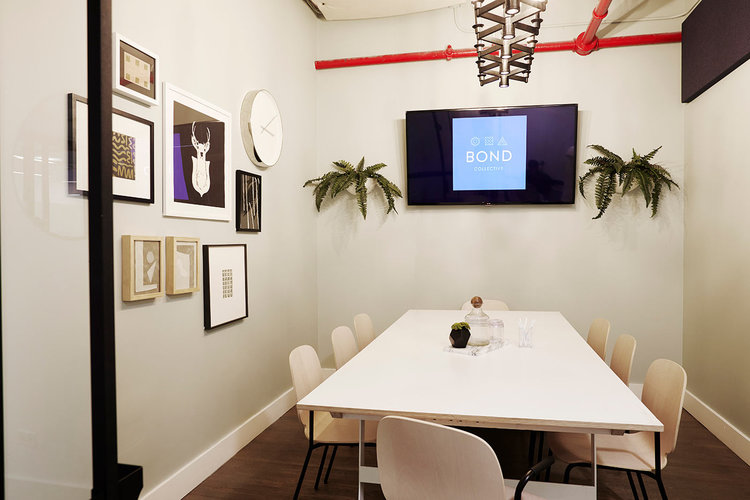
office space with conference-style table

You can only conduct business at your dining table for so long before you need a dedicated work environment. But you don’t want to sign a lease for an expensive office complex that may not fit your needs a few months down the road.

With coworking spaces like those offered at Bond Collective, you don’t have to deal with the expense and hassle of shopping for an office and then trying to outfit it for your business requirements. Bond Collective gives you everything you need to focus on bringing your startup to life.

5) Secure Investors

Every business needs capital. For startups, that means securing investors. The best way to find the funds you need is to be on the lookout for potential partners right from the beginning.

Don’t wait until a year into development before you begin seeking financing. By then it could be too late (or at least more difficult) to get the money you need.

Here are some simple ways to find investors for your startup:

  • Network at your coworking space

  • Consult an attorney

  • Approach family and friends

  • Pitch local business owners

  • Talk to established startup owners

  • Start a crowdfunding campaign

  • Advertise in an industry trade magazine

Get creative and think outside the box when you’re searching for fundraising avenues. This type of guerilla fundraising can help you stand out from the myriad other startups looking to secure investors.

Let Bond Collective Give You The Professional Image You Need

coworking space with desks, chairs, and computers

Regardless of the type of startup you have in mind, you’re going to need a professional image. But more than that, you’re absolutely going to need the requisite infrastructure to get the job done right. That includes things like:

  • Insanely fast Wi-Fi

  • 24-hour access

  • Custom build-outs

  • Private label mail service

  • Daily on-site cleaning

  • Access to conference rooms

  • Storage

  • Guest reception and greeting

The coworking spaces at any one of Bond Collective’s seven locations give you all that — a professional image and the amenities to boot — as well as the convenience and flexibility of a ready-made work environment.

workstation by window with computer, lamp, books, and cactus plant

Not sure how much room you’re going to need? Start with a shared workspace and then branch out to dedicated desks and even private offices.

Bond Collective gives you the flexibility to expand and contract your office space as needed to accommodate any business demand. That can help your startup save money and get the traction it needs to really get going.

For more business advice and to learn about the advantages of coworking spaces for startups, digital nomads, remote workers, and enterprises of all types and sizes, visit BondCollective.com today.


10 Easy And Effective Team-Building Activities For Work In 2021

Employees practicing team-building activity

By Carly Moore, Chief Of Staff, Bond Collective

Team-building activities for work are based on the premise that your employees interact in much the same way that a family interacts. So while they aren’t related by blood, they can benefit from many of the traits that make families strong: camaraderie, cooperation, and special bonds.

But how can you develop those qualities in a diverse group of employees to keep them motivated and cohesive? In this article, the experts at Bond Collective will show you 10 team-building activities for work that you can use to foster familial traits in your employees.

10 Easy And Effective Team-Building Activities

1) Food And Fun

Employees eating together as a team-building activity

Sharing a meal together is one of the most effective team-building activities for work because it helps your team draw close to one another.

Whether you choose to have food delivered or organize a potluck, gather everyone together during lunch or after work hours for some communal downtime. Take this opportunity to share difficulties and successes and ask each employee to relate an example they’ve experienced.

Don’t try to solve every little problem, and definitely don’t judge. Just provide a place where employees can relate what’s going on in their work life and see that others are feeling the same.

2) Office Happy Hour

Some of the best team-building activities for work are also the simplest. Case-in-point: the office happy hour. It doesn’t take much to get your employees involved. Just a place to gather and some food and drink. Then turn your team loose and watch them bond.

Here are a few ways to start this fun tradition:

  1. Leave the office early or gather after work hours and treat your team to a round of drinks at your favorite watering hole.

  2. Hire a portable bar and bartender and organize an office happy hour right where you work.

  3. Institute a wine or whiskey tasting one afternoon. Choose one drink, let everyone try it, and then go around the room and describe what they liked and disliked.

All of these ideas are a great way for your team members to relax, unwind, and get to know one another better.

3) Brainstorming Sessions

Employee brainstorming session

Brainstorming sessions are a great team-building activity for work because they help focus your employees’ minds on drawing together to solve problems in the business. Here’s how it works.

As leader of the session, pick two or more problems that need to be solved, gather everyone together, and allow everyone to throw out ideas. Make sure to stress that there are no bad ideas and point out that many of the best ideas have been built on the back of what, at first, seemed like a crazy notion.

Also, make it a point to keep things positive — no ridiculing or criticizing ideas. You want to create a safe space for employees to get creative.

4) Murder Mystery

The murder mystery (or any variation on this common theme) is a fun team-building activity for work that builds camaraderie and gives your employees a break from the stress of work.

Some variations are longer than others (so plan accordingly), but the basic premise of the game is that the teams must work together to question suspects, find clues, and, eventually, solve the murder or mystery.

5) Job Swap

Letting your employees work in another department every once in a while goes a long way toward building team unity and cohesiveness.

Every job comes with its own set of challenges. But your employees might overlook these challenges when they view the job from the outside. It’s an effective team-building activity and learning experience for employees to get a look at other jobs from the inside out.

6) Then And Now

This one takes a bit of preparation, but the results are well worth the effort. Ask employees to bring in baby pictures. Once you’ve collected all the pictures, post them on a wall somewhere, gather everyone around, and challenge employees to match the baby picture with the team member.

The game can be played as teams or as individuals, and answers can be oral or written. For an added bit of fun, institute penalties for wrong guesses or set a maximum number of guesses per turn.

You can even invent your own variations, so get creative and mix things up. One example is to find baby pictures of famous people and have your team members name the star.

7) Continue The Story

Pen and paper for work team-building activities

Prior to this game, write a few lines of a story at the top of a piece of paper. Write a different set of lines on another piece of paper. Repeat for as many pieces of paper as there are team members. If the size of the group is not restrictive, produce a piece of paper for every other employee or every third employee.

Attach each piece of paper to a clipboard for easy writing, and then gather everyone together in a circle. Make sure everyone has a pen. Distribute the clipboards around the circle.

Set a time limit (i.e., 30 seconds) and a sentence limit (i.e., 2), and then instruct team members to continue the story at the top of the page in whatever manner they see fit.

Once the time has expired or the sentence limit has been reached, employees pass the clipboards to the next person in line and the time starts again. When the clipboards return to the starting point, read each story out loud and vote on the best.

8) Office Olympics

If you want to reward your team for reaching a goal or give them an opportunity to de-stress after completing a difficult project, organize an office Olympics. It takes a bit of planning and preparation, but few things can bring a team together like a healthy dose of competition.

Here are some event ideas:

  • Typing test

  • Separate the beans

  • Balloon triathlon (blow them up, keep them aloft, pop them)

  • Crossword puzzle

  • Jumbo Jenga

  • Tie and untie

You can even play video games or leave the office completely for a round of Laser Tag if you’re feeling particularly ambitious.

9) Beach Ball Questions

This team-building activity for work is a fun and easy way to help team members learn about their colleagues and stay current with each other’s goals and activities.

Write random questions on a brightly colored beach ball. Questions can be simple (“What is your dog’s name?”, “What is your favorite food?”) or complex (“What are your weekly goals for the next month?”, “Where do you see yourself in five years?”), but a mix of both makes for a less taxing game.

Form a circle facing the center and toss the ball from person to person in a random order. After 10 seconds or so, say, “Stop.” The person holding the ball has to answer the question closest to his or her right pinky. Once they’ve answered the question, toss the ball again and repeat the process.

10) Pairs

Example of team-building activities

Pairs is another excellent team-building activity for work that helps team members get to know one another.

First, come up with as many pairs as you can think of (e.g., peanut butter and jelly, yin and yang, salt and pepper, dark and light, male and female, Minnie and Mickey, noise and silence, hard and soft). Then write each word of the pair on a separate piece of paper (yin on one piece, yang on another).

Next, gather everyone together, tape a piece of paper on their backs, and instruct the participants to find their opposite half. To do this, they can only ask Yes or No questions.

When they find their match, they must sit down together and learn three to five interesting facts about one another.

Build Your Team With A Happy, Productive Office Environment

Shared office space at Bond Collective

Team-building activities for work are a powerful way to encourage teamwork, but you can’t play a game or hold a happy hour every day. Instead, make your office environment a happy and productive place. This is one of the most effective ways to encourage employee engagement and unity.

If your workspace isn’t as inspiring as you’d like, consider the benefits of a coworking space like Bond Collective. Bond Collective provides everything from communal work environments to dedicated desks to private offices. You even have access to plush conference rooms to suit all your business needs.

Conference room at Bond Collective

Add to that Bond Collective’s many amenities, such as:

  • Lightning-fast internet

  • 24-hour access

  • Custom build-outs

  • Private label mail service

  • Daily on-site cleaning

  • Bike storage

  • Concession food market

  • Guest reception and greeting

With all those benefits available at every one of Bond Collective’s seven locations, it’s easy to see how their coworking spaces draw your team members together in a cohesive unit and give them the ability to succeed at any problem, task, or project that comes their way.

For more business advice and to learn about the advantages of coworking spaces for startups, digital nomads, remote workers, and enterprises of all types and sizes, visit BondCollective.com today.
What Is Business Development And How Is It Different Than Sales?

Man researching what is business development

By Michael Braun, Enterprise Sales Manager, Bond Collective

If you’re new to the business world (and even if you’re not), you may be wondering what is business development and is it different than sales? The short answer is yes, business development and sales are two very different activities.

But how exactly do they differ? Is there any overlap? And what are the responsibilities of each position? In this article, the experts at Bond Collective tell you everything you need to know about these essential positions in your business.

What Is Business Development?

The answer to the question, “What is business development?” is fairly simple. It’s all about finding and generating new leads. How is that different than sales? Let’s use an illustration. Think of both business development and sales as excavating an underground power supply (i.e., a new lead).

In that case, business development is like the first step in the digging process: removing great swaths of extraneous material that is hiding your goal with a backhoe or excavator. Your business development professionals are like those pieces of heavy equipment. They work to identify potential markets, make contact, and develop leads.

Going back to actual excavation, once the power supply is unearthed, the heavy equipment moves out of the way so workers with hand tools can do the more dexterous work. That brings us to sales.

What Is Sales?

Put simply, sales is about generating transactions and closing deals. In our excavation analogy, sales is like getting in there with a shovel and brush to completely uncover the underground power supply so that it can be repaired.

You wouldn’t do that kind of fine, detailed work with a backhoe — the backhoe is too big and too imprecise. You run the risk of destroying what you were digging for. The heavy equipment — the business development professional — did its job getting you close to the goal. Now it’s up to the sales team to take it the rest of the way.

As great as analogies are for helping you understand the big picture, they are limited in their scope. To really understand what is business development and what is sales, we need to drill down to the details of each job.

What’s The Difference Between Business Development And Sales?

Business development professional walking up steps

Before we get too deep into the discussion, let’s reiterate the answer to the question, “What is business development and what is sales?”

Business development is about finding leads. Sales is about turning those leads into customers.

The easiest way to make a distinction between the two is to examine the responsibilities of each position.

Business Development Responsibilities

Here are the basic responsibilities of business development:

  1. Qualifying leads from marketing campaigns

  2. Classifying leads as sales opportunities

  3. Researching potential customers

  4. Contacting potential customers

Sales Responsibilities

Here are the basic responsibilities of sales:

  1. Nurturing leads

  2. Closing deals

  3. Maintaining existing relationships

Business development comes first — they find the leads. Then sales steps in to grow those leads into customers.

Should Business Development And Sales Be Separate Positions?

In the early stages of your business, it may be necessary to combine business development and sales into one position. As a startup, you may not have the capital or the manpower to maintain separate business development and sales position. In fact, many a founder and CEO wears both hats (plus many more) when their business first gets going.

Eventually, though, as your business grows and develops, you should separate business development and sales into distinct positions (or at least distinct divisions within the sales department).

This allows your employees in each job to focus on one specific skill set. Uncovering leads and closing deals require different abilities. There is some overlap, but the jobs are different enough that they warrant a bit of separation.

Having an employee focus on one or the other frees up their calendar and allows them to specialize. This specialization then helps them develop their skills at a more rapid pace. When they have to do both jobs, they tend to wear themselves too thin and are unable to excel at either activity.

5 Traits Of A Good Business Development Or Sales Rep

Manager researching what is business development

1) Communication

Good communication is vital for both business development and sales reps. Without it, there’s little chance that a lead will move through the sales funnel to become a customer.

Communication encompasses a range of skills, including but not limited to:

  • Clarity of meaning

  • Getting along with others

  • Persuasion

  • Getting people to listen to your ideas

  • Empathy

If you want to build strong relationships with potential and long-time customers alike, your business development and sales reps need to have strong communication skills.

2) People Skills

Like communication, people skills are crucial for success as a business development professional or sales rep. And like communication, people skills have a wide variety of facets, such as:

  • Patience

  • Flexibility

  • Trust

  • Interest in others

  • Ability to listen

  • Good judgment

  • An open mind

  • Honesty

  • Adaptability

These skills will help both business development pros and sales reps develop the relationships necessary to cultivate relationships with clients and customers.

3) Drive

Both business development and sales reps need drive to be successful in their given field. A laissez-faire attitude is counterproductive for your employees when they’re trying to cultivate customer relationships and reach their goals. They need an inner drive that motivates them to put in the long hours to find a potential lead or make a sale.

That drive also helps your business development and sales reps avoid succumbing to discouragement when negotiations don’t go their way or deals fall apart.

4) Discipline

Even highly-motivated (driven) professionals experience failure at one point or another. A good business development or sales rep will have the discipline to get back on their feet and keep going in the face of rejection.

They know that all it takes is one more phone call or one more email to experience success again. It requires a special kind of discipline to push through the failure, to get back on task, and to continue executing at a high level. That’s what you want to find or develop in your sales team.

5) Confidence

Good business development and sales reps are confident in their abilities to get the job done. But confidence doesn’t always come easy. It takes experience — success and failure — to develop the confidence necessary to be successful.

It’s great if a potential business development rep or sales rep exhibits all five traits, but don’t hold your standards too high. All of these skills can be taught and improved with the right training program and a healthy dose of experience.

Don’t hamstring your hiring process by holding out for an employee with all five of these skills. If you interview someone who has excellent people skills and a drive to succeed, move them to the top of your list. You can develop the other three traits after they’re on the job.

Take Your Business Development And Sales To The Next Level

Work space for business development professionals

Whether you’re a one-person business development/sales rock star or you’re part of a dedicated team of 10, where you work has a profound impact on your success. If your team is spending eight, 10, even 12 hours in a shabby workspace, their focus, engagement, and morale will be affected.

And don’t forget the very real possibility that clients and potential investors may want to drop by your offices to touch base. The lack of a professional image at that point can be disastrous to both your business development and sales.

Bond Collective Coworking Space

That’s why it’s vital for the success of your business to take advantage of the myriad benefits of a professionally designed and maintained coworking space offered by Bond Collective. With seven locations to suit your every need, Bond Collective is the go-to solution for businesses of all sizes.

At Bond Collective, you get more than just a beautiful and spacious work environment. You’ll also benefit from the low overhead inherent in the shared workspace concept and infrastructure — like lightning fast internet, storage, snack bar, and on-site technical support — that you might not be able to afford on your own.

So whether you choose a coworking space, a dedicated desk, or a private office for you or your team, the work environment will allow you to focus on what’s most important: taking your business development and sales to the next level.

For more business advice and to learn about the advantages of coworking spaces for startups, digital nomads, remote workers, and enterprises of all types and sizes, visit BondCollective.com today. We know what businesses need.

The 12 Best Entrepreneur Books Every Startup Founder Needs To Read

Woman's arm reaching for a book on a shelf of books

By Shlomo Silber, CEO & Co-Founder, Bond Collective

As an entrepreneur and founder of a startup, there’s one simple thing you can do to benefit yourself and your business: read. More specifically, read the best entrepreneur books out there to get a jump-start on your competition.

Reading books by leaders, business owners, other entrepreneurs, and those in the know gives you access to valuable knowledge that you can’t find anywhere else.

Even if you have a great idea and a plan to make that idea a reality, you can still benefit from other’s successes and failures. That’s what reading the best entrepreneur books is all about: following in the footsteps of those who have gone before you and learning from their mistakes and triumphs.

To help you find just the right book for your specific goals, we’ve created a list of the 12 best entrepreneur books that every startup founder needs to read. With the books on this list, you can get started improving the way you think about — and work on — your business.

The 12 Best Entrepreneur Books

1) The Achievement Habit

Cover of The Achievement Habit

In The Achievement Habit, Dr. Bernie Roth asks (and answers) a question every entrepreneur and startup founder should be asking themselves: Am I solving the right problem? Dr. Roth then helps you identify and conquer those obstacles with clear and actionable strategies.

2) Think And Grow Rich

Cover of best entrepreneur book Think and Grow Rich

In the original Think and Grow Rich, published in 1937, Napoleon Hill draws on stories of Andrew Carnegie, Thomas Edison, Henry Ford, and other millionaires of his generation to illustrate the principles of success.

In the updated version, Arthur R. Pell, Ph.D., relates anecdotes of how contemporary millionaires and billionaires, such as Bill Gates, Mary Kay Ash, Dave Thomas, and Sir John Templeton, achieved their wealth. You can’t go wrong with what has been called the “granddaddy of all motivational literature.”

3) The Obstacle Is The Way

Cover of entrepreneur book The Obstacle Is The Way

In The Obstacle is the Way, author Ryan Holiday shows you how some of the most successful people in history — from John D. Rockefeller to Amelia Earhart to Ulysses S. Grant to Steve Jobs — applied stoicism (the philosophy of enduring pain or adversity with perseverance and resilience) to overcome difficult situations.

So if you’re feeling frustrated, demoralized, or stuck in a rut, this book can help you turn your problems into your biggest advantages.

4) The E-Myth Revisited

Cover of one of the best entrepreneur books, The E Myth Revisited

The E-Myth Revisited by Michael E. Gerber is an updated version of the phenomenally successful original. In this latest edition, Michael Gerber dispels the myths about starting your own business. Along the way, he points out how common assumptions, expectations, and even technical expertise can get in the way of running a successful business.

5) Tools Of Titans

Cover of Tools Of Titans by Tim Ferriss

In Tools Of Titans, author Tim Ferriss relates the business lessons he’s learned from celebrities, athletes, special-ops commanders, and black-market biochemists (just to name a few). Through it all, Ferriss keeps a relentless focus on actionable details so that you can translate the experiences into real-life strategies.

6) The Fountainhead

Cover of popular book Fountainhead

The Fountainhead by Ayn Rand sums up the entrepreneurial passion and spirit when it states, “The question isn’t who is going to let me, it’s who is going to stop me.” And that’s just the tip of the iceberg. Countless successful people around the world recommend this book as required reading for every entrepreneur.

7) The $100 Startup

Cover of entrepreneur book The $100 Startup

In The $100 Startup, Chris Guillebeau shows you how to lead a life of adventure, meaning, and purpose — and earn a good living at the same time.

Guillebeau reveals how to turn ideas into income and proves that you don’t need an MBA, a business plan, or even employees. All you need is a product or service that springs from what you love to do anyway, people willing to pay, and a way to get paid.

8) The Effective Executive

Cover of the book The Effective Executive

In The Effective Executive, author Peter F. Drucker shows you that the measure of any good executive is the ability to “get the right things done.” This usually involves doing what other people have overlooked as well as avoiding what is unproductive.

Intelligence, imagination, and knowledge may all be wasted in an executive job without the acquired habits of mind that mold them into results. In his book, Drucker demonstrates the distinctive skill of the executive and offers fresh insights into old and seemingly obvious business situations.

9) Deep Work

Cover of best entrepreneur book Deep Work

According to Deep Work author Cal Newport, deep work is the ability to focus without distraction on a cognitively demanding task. It’s a skill that allows you to quickly master complicated information and produce better results in less time.

Deep work will make you better at what you do and provide the sense of true fulfillment that comes from craftsmanship. In short, deep work is like a superpower in our increasingly competitive twenty-first-century economy.

10) The Innovator’s Dilemma

Cover of The Innovator's Dilemma by Clayton M. Christensen

In The Innovator’s Dilemma, author Clayton M. Christensen shows how even the most outstanding companies can do everything right yet still lose market leadership. No matter the industry, Christensen says, a successful company with established products will get pushed aside unless managers know how and when to abandon traditional business practices.

Christensen then gives you a set of rules for capitalizing on the phenomenon of disruptive innovation.

11) The 10X Rule

Cover of The 10X Rule by Grant Cardone

The 10X Rule by Grant Cardone unveils the principle of “Massive Action” which allows you to blast through business clichés and risk-aversion while taking concrete steps to reach your dreams. It also demonstrates why people get stuck in the first three actions (no action, retreat, and normal action) and how you can prevent these pitfalls.

Find out exactly where to start, what to do, and how to follow up each action you take with more action to achieve “Massive Action” results.

12) Business Adventures

Cover of the entrepreneur book Business Adventures

Business Adventures, written by longtime New Yorker contributor John Brooks, is an insightful and engaging look into corporate and financial life in America.

Brooks provides lessons for all businesses — large and small — using real-life examples like the Edsel (a $350 million disaster), Xerox, and General Electric and how these iconic companies were defined by a particular moment of fame or notoriety. Brooks shows that you can learn a lot from the business adventures of others.

13) Blink

Bestselling inspirational book Blink by Malcolm Gladwell

Blink, by Malcolm Gladwell, explores the science behind decision-making and intuition and shows how these skills are essential for any aspiring business leader.

Blink reveals that great decision makers aren’t those who process the most information or spend the most time deliberating, but those who have perfected the art of “thin-slicing” — filtering the very few factors that matter from an overwhelming number of variables.

Improve The Way You Work

Shared open office space

Reading these 12 best entrepreneur books is a great start for any founder looking to get ahead. But success is about more than just the words on a page. You’ve got to take action.

One of the best ways for an entrepreneur to bridge the gap between book and business is to put the advice into practice with other like-minded startup founders. To really make an impact in your business, you need to spend time talking to your peers about what they’re dealing with and how they’re coping with the challenges of running a startup.

But where can you find that type of environment? Coworking spaces like those offered by Bond Collective.

Women discussing the Best Entrepreneur Books

With coworking space, not only will you enjoy working alongside and learning from entrepreneurs from every corner of the business world, but you’ll also benefit from the low overhead inherent in shared workspace and the infrastructure (internet, heating and cooling, snack bar, storage, technology, etc.) that you might not be able to afford at this stage of your startup.

And then there’s the professional image that all seven Bond Collective locations present to your employees and customers alike. Whether they’re working there full-time or visiting to close a deal, everyone will enjoy the comfort and luxury built into each corner of our office environment.

Coworking space at Bond Collective

Whether you opt for a coworking space, a dedicated desk, or a private office, you’ll get access to all the benefits mentioned above, plus a rich network of entrepreneurs and founders who can help you make your startup dreams into business realities.

To get started or to learn more about coworking space benefits for digital nomads, entrepreneurs, startups, remote workers, and businesses of all sizes, visit BondCollective.com today.

How To Find Investors For Startups And Small Businesses

Graph showing How To Find Investors

By Shlomo Silber, Co-founder and CEO, Bond Collective

It’s not an exaggeration to say that raising money is essential for the success of your startup or small business But as crucial as it is, many first-time entrepreneurs are confused about how to find investors in the early stages of their company’s development.

One of the keys to funding success is starting early. Don’t wait until your product is six months into development before you begin seeking financing. Be on the lookout for investors from day one. And once you’ve started searching, never stop.

Even if you’re not quite ready or if you’re in-between rounds, you should always entertain investment interest. Maintain a list of potential financing opportunities, and contact them when it’s time for an injection of capital.

Need more actionable methods for raising money? Here’s how to find investors for startups and small businesses.

How To Find Investors: 10 Expert Tips

1) Join A Coworking Space

Bond Collective coworking space

The benefits of using a coworking space, like Bond Collective, for your startup are almost too numerous to list. You can save money on overhead, get the infrastructure you need without breaking the bank, and convey a professional image when all you really have is an idea.

On top of that, coworking spaces are great places to network and find investors for your startup or small business. Entrepreneurs just like you may have leads on investors who helped them out in their time of need.

Additionally, those same entrepreneurs may now be in a position to invest in your startup themselves.

2) Consult An Attorney

It’s always smart to have an attorney available for your startup or small business. They can help you in all manner of corporate structuring, legal documentation, and tax law. They can also help with how to find investors when it’s time to raise funds.

Chances are, you’re not your attorney’s only client. They likely deal with hundreds of business owners just like you.

Some of those business owners will be new. Some will have been in the industry for years. Some may have even graduated to investing full time. Regardless, your attorney will know who’s ready and willing to provide financing.

3) Consider Asking Family And Friends

Mixing your personal life with your business life can be a tricky proposition. But your family and friends can be a resource for how to find investors for your startup or small business. Some of them may even want to personally invest.

The first step is to ask your family and friends if they know of anyone who would like to invest in a fledgling business. The second step is to ask your family and friends specifically if they would like to invest in your startup.

Either way, it’s critical to act professionally at all times and to document everything so that there’s no confusion or hurt feelings later on.

4) Approach Local Business Owners

Local business owners can be a great resource on how to find investors for your startup or small business. Like you, they probably needed funding in the past and can point you in the right direction in terms of connecting with people and organizations that are ready to invest.

If your product or service somehow benefits their existing company, those local business owners may want to become investors themselves. Start by asking for names of other investors, but don’t be afraid to pitch your startup’s prospects if the business owner shows interest.

5) Talk To Established Entrepreneurs

Woman working outside at a restaurant

Established entrepreneurs can also be a wealth of information about how to find investors for your startup or small business. Network through your local chamber of commerce or Better Business Bureau.

Attend events in your town, join tech, startup, and business groups on social media, and basically try to meet as many people as you can.

As you do those things, don’t go heavy on the pitch all the time. Get to know your peers and bond over the joys and hardships of starting your own business. As a result, you’ll build strong relationships that can reap rewards when it’s time to secure financing.

6) Spread The Word Through Industry Friends

Many investors specialize in specific markets, so if you have friends in your industry, contact them for recommendations. And don’t limit yourself to business owners. Even if your industry friends aren’t business owners themselves, they can have valuable information on who’s willing to invest.

If you don’t find any leads when you first ask, don’t be discouraged. You’ve planted the seed. Sometime down the road, that seed may grow into a full-fledged opportunity.

7) Contact Local Business Schools

Local business schools are another source for how to find investors. They often have a network of faculty, alumni, and guest speakers who might know of investors — or be investors themselves — who are looking for the next big thing.

Additionally, don’t limit yourself to business schools. If you earned an undergraduate or graduate degree from a college or university, contact them about financing leads. They’re often happy to help out an alumnus or alumna.

8) Investigate Online

The internet can be a valuable resource for finding investors if you look in the right place. There are numerous websites that work to connect startups and small businesses with investment capital. Even LinkedIn and Quora can be useful if you connect with the right people.

Try to find resources that don’t cost anything, and be sure to establish credentials before making any promises. If in doubt, meet face-to-face to get a better feel for the investor and to give them a clearer picture of your business.

9) Start A Crowdfunding Campaign

Crowdfunding is a relatively new method for how to find investors, but it’s already turned into a very viable and successful option for fledgling businesses. Even several small investments can quickly add up to some pretty impressive numbers.

If you don’t get all the money you need in one campaign, it can be a great demonstration of what you can do with a little bit of financial help. Use the funds wisely, grow your startup, and then use that example in your pitch for the next round of investments.

10) Advertise

Finding investors is all about spreading the word. And what reaches more eyes and ears than advertising? Consider placing an ad in an industry trade magazine or investment publication. It’s not conventional, but it may just get results.

Keep it short and simple — “Investors Wanted” — and use it as a way to get your essential startup information in front of as many people as possible.

Man reading a newspaper at a coffee shop

Thinking Outside The Box

There’s no one right way to find investors, just as there is no one right way to market and advertise your business. In fact, you can (and should) take a page from the marketing playbook and go guerilla in your fundraising efforts.

Think outside the box and you’re likely to come up with novel and unique ways to find investors that aren’t on anybody else’s list. The nice thing about guerilla fundraising is that it’s specifically tailored to your startup or small business. Plus, it will help your company stand out from amongst the thousands of other startups looking for financing.

Use the ideas on this list as a starting point, and then get creative and come up with your own special ways for how to find investors. Your business will benefit as a result of your efforts.

Keeping Track Of Investments

Business owner working

Whenever, wherever, and however you find funding, it’s essential to keep track of the investments made in your startup or small business.

Without some record of what’s come into your company, you’ll have no way of knowing how much you owe each investor. That’s why it’s vital to create and maintain a cap table for your business.

A capitalization table (cap table for short) is a document that illustrates the capitalization of a company. More specifically, a cap table lists all the shareholders and their corresponding assigned stock. You then use the cap table to track the total amount of shares, the value of those shares, and the equity ownership of all your startup’s shareholders.

Invest some time in the creation of your cap table. Refer back to it regularly and keep it updated as funding rolls in. That way, you’ll be prepared when your startup hits it big and the time comes to start paying back your investors.

To learn more about how coworking space benefits startups, small businesses, remote workers, and companies of all sizes, visit BondCollective.com today.

Estimating Market Size: The Complete Guide For Startups And Small Businesses

Example of Market Size

By Gregg Jackowitz, Managing Director of Sales and Marketing, Bond Collective

Estimating market size is a crucial first step in the development of any startup or small business. And it really doesn’t matter what industry you’re in — or want to be in — getting an accurate picture of your market size reveals insights that can drive both the present and future success of your business.

Why is knowing your market size so important? And how can you get started putting together a realistic profile of your target market? We’ll answer those questions in this article.

Why Is Knowing Market Size Important?

Put simply, estimating your business’s market size will provide you with key data points. Those data points will then inform your decisions for the present and help you grow your business over time.

Here are four key variables that you can uncover by evaluating your market size.

1) Strategy

Tools for estimating market size

Market size has a dramatic effect on the strategy your startup uses in the present and near future. Think of market size as a roadmap that you can reference to get to your destination.

If you know where you are and where you want to go, you can use the map — the data that market size reveals — to plot out a course and make decisions. With a map in hand, your choices are clearer because you’re not trying to target everyone, just a distinct group of people.

More specifically, market size influences components of your business such as:

  • Hiring

  • Office space (i.e., how much)

  • Valuation

  • Pricing

  • Raising capital

  • Developing new products

2) Advantage

Every startup needs a competitive advantage. Estimating market size before making any big moves helps that advantage coalesce.

While your product (or service) has a wide potential market, realistically, your business can only capture a small percentage of that market. Once you’ve identified that percentage — through estimating market size — you can determine what features and what value-adds will give your startup a competitive advantage over all the other startups vying for the same market share.

This will help you set your product apart, position it as unique, and achieve the success you’re looking for.

3) Trends

Women shopping

The business market as a whole is a big place. Even your specific piece of that market (let’s say pens) is a big place. But after estimating your market size, you’ll get a much clearer picture of your target demographic (the people who will be buying your pens).

This knowledge will allow you to do two things that your competitors can’t:

  1. Identify trends in consumer behavior

  2. See whether your industry is growing or declining

Armed with that knowledge, you can begin to formulate your business strategy and gain the competitive advantage we talked about earlier.

4) Profitability

Profitability is the goal of every startup and small business. Identifying your market size makes profitability possible, or at least more probable.

Estimating your market size reveals whether or not there are enough potential customers who will actually buy your product. With that number, you can find out if the price you’ve set will move your business into the black. It will also show you whether the market you’re going after is too small to create the profit you need.

Now that you understand why estimating market size is crucial to your business’s success, we’ll show you how to get started doing it.

5 Essential Steps For Estimating Market Size

1) Clarify The Problem Your Product Solves And The Value It Generates

This is a step that many startups and small businesses skip because they’re excited about the product and are chomping at the bit to get going. Resist the urge to jump right in before clarifying the problem your product solves and the value it generates (understanding your own brand).

For example, if you produce a pen that uses 50 percent less ink than similar pens, you’ve solved the problem of people quickly running out of ink. As a result, your customer doesn’t have re-fill or replace their pen as often, which is also better for the environment. That’s the problem solved and the value it generates.

Of course, this is a very simple example and there are doubtless other problems solved and value-adds associated with our hypothetical pen. But this basic information will help you narrow down your target audience in the steps below.

2) Identify Your Market & Define Your Target Customer

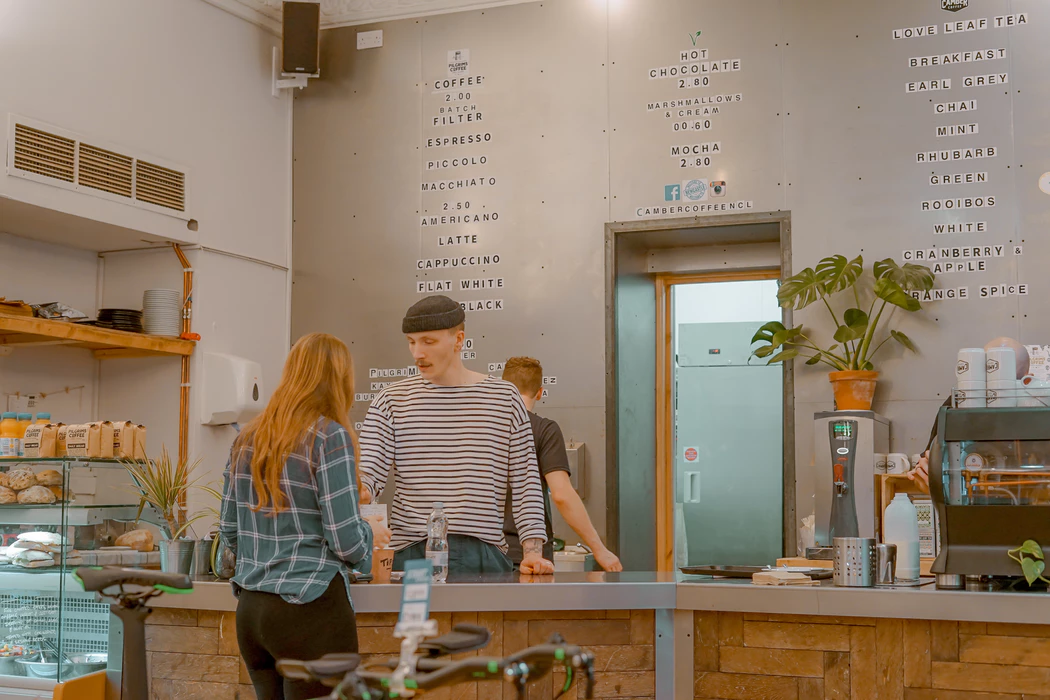
Customer and barista at a coffee shop

The next step in estimating your market size is to identify your market and define your target customer. If we continue with the pen-as-product analogy started above, then our market is all pen users. That immediately eliminates young children who are more likely to use pencils or crayons.

Even without the young children, we still have an extremely large market (all people over the age of 12, let’s say). But are we trying to sell to all of them? No. The problem(s) our pen solves and the value it generates eliminate even more of the market.

With this information, we define our target customer as business people with an appreciation for quality writing instruments. Let’s say, for the sake of argument, that those people — our target customer — make up 20 percent of the total pen market (all pen users). Hypothetically, then, that leaves us with 2.3 million potential customers.

3) Estimate Your Part Of The Market & The Number Of Target Customers

As a startup or small business with realistic expectations, you know you won’t achieve 100-percent market share (even the largest, most established businesses never do). So what part of that 20 percent can we access right away?

Most startups and small businesses can expect to access somewhere between one and five percent of their target market at the beginning.

To make the math easier, let’s say that our pen startup expects to achieve five percent of the target market (or one percent of the total) from day one (0.05 x 0.20 = 0.01). Applying that estimate to our 2.3 million potential customers reduces the number to 23,000 (0.01 x 2,300,000).

So that’s our part of the market and the number of target customers: one-percent or 23,000 people.

4) Calculate Your Market Volume

The first step to calculating market volume is to estimate your market penetration. Products that are mission critical (like computers) or are mandated through regulation have a higher penetration rate (indicated as a percentage). Products with a specialized purpose (like oil-drilling bits) have a lower penetration rate.

We’ll estimate our penetration rate in the lower-middle percentages (40%) because, although they’re not mission critical, our pens are still very necessary for our target customers.

Now, we’ll use that number (40%) to calculate our market volume. Here’s the equation:

Number of target customers x Penetration rate = Market volume

23,000 target customers x 40% penetration rate = 9,200 market volume

With that number, we can then calculate our potential market value.

5) Calculate Your Potential Market Value

Pile of cash

We can calculate our potential market value in one of two ways: based on the price we charge for our pen or on the profit we make after production. We suggest doing both to get a more accurate picture of your business’s profitability.

For simplicity’s sake, we’ll stick with the price we charge for our pen. Here’s the equation:

Market volume x price = market value

9,200 market volume x $2.00 = $18,400

That tells us that we can expect to make an estimated $18,400 from just 1 percent of our target market. It also tells us there’s plenty of room for growth.

Armed with these numbers and your estimated market size, you can position your startup or small business to have the highest chance for success. But there’s one more thing to keep in mind.

Be Realistic About Your Market Size Estimates

If you want to get an accurate picture of your market size, you need to be realistic in your estimates and projections. What realistic means for you depends on your business, your experience, the data available, and a host of other factors.

But the foundation of it all is remaining objective and impartial throughout the entire process. When you can do that through all 10 steps, you’ll be able to get a very realistic — very accurate — estimate of your market size. With that information, you can set your startup or small business on the road to success.

To learn about how coworking space can benefit startups, small businesses, remote workers, and companies of all sizes, visit BondCollective.com today.

Cap Table For Startups | The Complete Guide

CEO happy with his cap table

By Sally Forman, Controller, Bond Collective

If you’re part of a startup, you’ve probably heard the words “cap table” one or two times. That’s because the cap table is an essential part of a company’s structure and valuation. In fact, creating a cap table is — or should be — one of the first steps in forming a startup.

But what exactly is a cap table, and why is it so important? The experts at Bond Collective answer those questions and more in this article.

What Is A Cap Table?

A capitalization table (or “cap table” for short) is a table illustrating the capitalization of a company. More specifically, a cap table is a listing of all the shareholders and their corresponding assigned stock. A company then uses the cap table to track the total amount of shares, the value of those shares, and the equity ownership of all the startup’s shareholders.

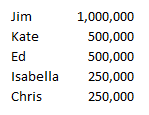
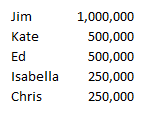
Cap tables are usually kept in a ledger or a spreadsheet. So, in the most basic form, a cap table is simply a column of names (the shareholders) with a column of numbers (shares) next to it. It might look something like this:

Simplified example of a cap table

From this, you learn that Jim holds 1,000,000 shares, Kate holds 500,000 shares, and so on. And assuming this is the complete list, you also learn that the total number of shares amounts to 2,500,000.

Keep in mind that the names and numbers above are an extremely simplified version of what a cap table will look like. Completed cap tables can be very complicated. Exactly how complicated depends on how you structure the stock in your startup.

Why Is A Cap Table Important?

Managers meeting and taking notes

The cap table you produce for your startup is important because it illustrates who has control — ownership — of the company. So in the table below, Jim has twice as much “leverage” as Ed.

Simplified example of a cap table

Viewed from a different angle, if one vote equals 1,000,000 shares (let’s say it’s a “Yes”), both Kate and Ed would have to be in agreement (with a “No”) to counteract Jim’s vote. This can have a dramatic impact on the decision-making process of the startup and the ultimate direction it takes.

Another important aspect of the cap table is that it represents money — a potentially significant amount of money. Investment in a startup can range anywhere from the low five figures to the high seven figures (or even more). Then as the startup grows and becomes profitable, that stock can double or triple in value. Even a small error on a cap table can mean a difference of hundreds-of-thousands, if not millions, of dollars.

In the beginning, however, ownership and dollar value may not be as critical because the startup has yet to accomplish anything. Even so, the cap table is still important because:

  • Potential investors can use the information to evaluate how much control and leverage they will get for their money.

  • Current investors can see who has control and can use the data to forecast their position (and potential profit) in the company.

  • Stockholders can see the value of their shares in real time.

  • The data provides historical insight that can affect your startup’s valuation when it comes time for a new round of fundraising.

  • It allows you to accurately present your company’s history and holdings in the event of an audit.

  • Founders can use the information to quickly determine what percentage of the startup they have to offer a new investor.

As you can surmise, the importance of a well-set-up and well-maintained cap table increases the longer your business exists. That’s why it’s key to the success of your startup to get it right the first time.

How To Read A Cap Table

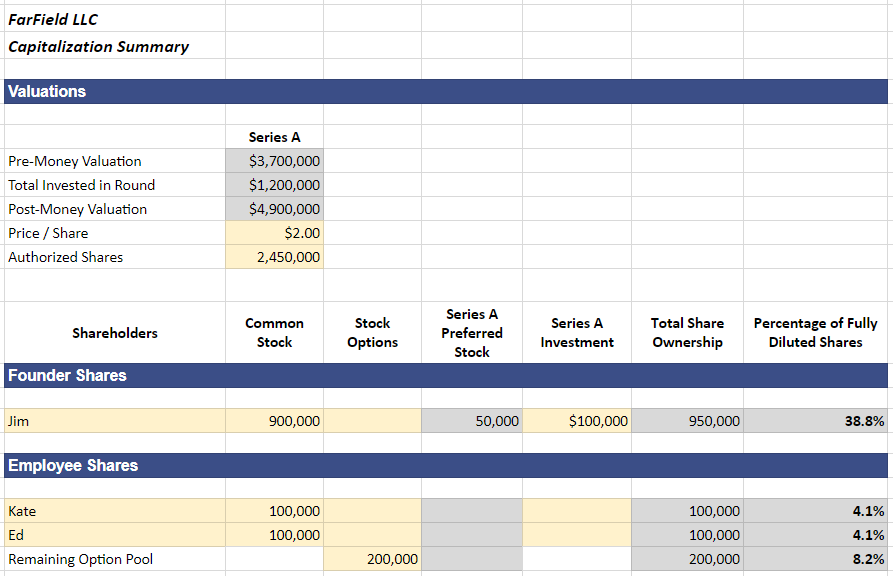
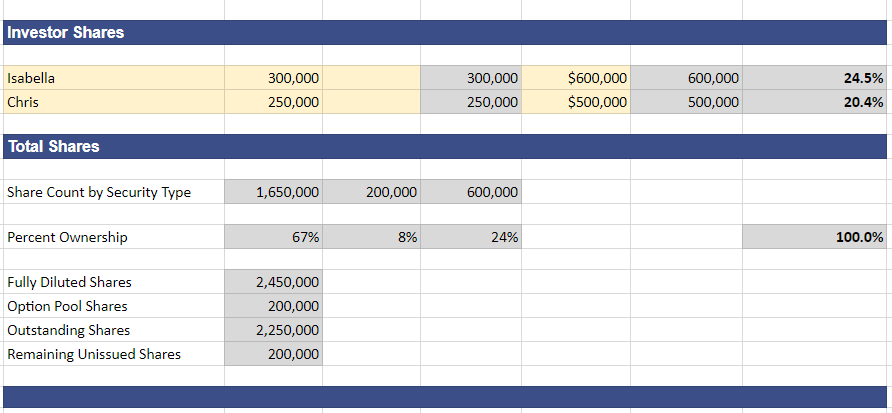
Cap Table example

Cap Table example

Series A

This term refers to the round in which your startup is raising money. In the future, your startup may need to raise more money. At that time, you would calculate another round of investments (Series B).

Pre-Money Valuation

Two business men in suits shaking hands

This is the value of your startup before any investment occurs. Pre-money valuation is usually set by negotiation between company management and investors.

Post-Money Valuation

This is the value of your startup after an investment has been made. It’s calculated by adding the pre-money valuation and the total dollar amount of the investments raised.

Price Per Share

As the name suggests, this is the price for one share of stock in your startup. It’s calculated with the following formula:

Pre-Money Valuation / (Common Stock + Stock Options) = Price Per Share

In this cap table, the price per share is $2.

Authorized Shares

The authorized shares (or securities) are the total number of shares that have been authorized for issuance by your startup’s owners.

Common Stock

Common stock is the most basic form of ownership in your startup.

Stock Options

A contractual right to purchase a specified number of shares at future date.

Preferred Stock

Preferred stock is a class of stock with special rights as outlined in your startup’s charter. There are different types of preferred stock including:

  • Convertible

  • Participating

  • Non-participating

They all come with a different set of privileges.

Investment

This refers to the dollar amount invested during a particular series (in this case, Series A).

Total Share Ownership

Contract For A Cap Table

Total share ownership is the sum of the common stock, stock options, preferred stock, and any other category of stock for a single individual.

Percentage Of Fully Diluted Shares

We’ll explain fully diluted shares below, but this column basically shows you how much of the company a specific individual owns. Founders and high-dollar investors typically own a larger percentage of the fully diluted shares.

Remaining Option Pool/Option Pool Shares

These shares — often referred to as simply “the pool” — are reserved for later issuance by your startup when stock options are purchased. These are often included in a compensation package for employees working in the startup.

Keep in mind that option pool shares are not outstanding shares (explained below) so no stockholder owns them.

Share Count By Security Type

Security type refers to the various categories of stocks — common, options, preferred — that your startup can issue. This particular section shows you the total amount of each of the security types issued.

Percent Ownership

Percent ownership shows you what chunk of the authorized shares (as a percentage) each person owns.

Fully Diluted Shares

Fully diluted shares refer to the number of shares that would be available if all possible sources of stock were converted. For example, if you had to liquidate your startup (convert everything to cash), the fully diluted shares indicates the value.

Outstanding Shares

This is the total number of shares that have been issued. The outstanding shares category does not include:

  • Stock options that have not been granted (the pool)

  • Granted options that have not be exercised

Remaining Unissued Shares

The remaining unissued shares value tells you the total number of shares you have left to issue. It includes all security types (common, options, preferred, etc.).

Other Terms You May See

Graph Representing a Cap Table on a computer screen

Warrants

Warrants are like options. They are a contractual right to purchase a specified number of shares for a specified price at a specified future date. Warrants may use shares set aside in the pool, but they are typically “one-offs” and are not included in the stock option plan. Warrants tend to be issued as a form of currency in business transactions.

Restricted Stock

Restricted stocks (or restricted shares) are granted up front with restrictions that reduce over time. This is in contrast to stock options which are granted at a later date with rights that increase over time.

Restricted stock is being used more and more in place of stock options because of its greater potential tax efficiency.

Invest Time In Setting Up Your Cap Table

As you can see, a well-organized cap table is the lifeblood of your startup and should be treated as such. It’s always a good idea to invest some time in setting up your cap table. That way, all your ownership and monetary bases will be covered before you get into the thick of actually running the business.

For more business advice and to learn about the advantages of coworking spaces for startups, digital nomads, remote workers, and enterprises of all types and sizes, visit BondCollective.com today.

The Top 14 Ways To Motivate Employees In 2021

Woman explaining how to motivate employees

By Ashley Espinal, Head of Community, Bond Collective

The best managers know how to motivate employees, and they use that knowledge on a daily basis. These professionals understand that a motivated team is the holy grail of today’s business, so they do everything they can to keep their employees focused and engaged.

But how exactly should you go about doing this? The experts at Bond Collective give you 14 of the best ways to motivate your employees.

How To Motivate Employees

1) Make Your Business A Nice Place To Work

Kitchen in a luxury coworking environment

One of the best ways to motivate employees is to give them a nice place to work. This doesn’t just apply to their cubicle or desk. The concept of a motivational space extends to every corner of the workplace environment (and even beyond it).

The bathrooms, the break room, the lounge, the outdoor space (e.g., the roof or patio), even the neighborhood in which your office is located — all of these areas can have a profound effect on your employees’ motivation.

That’s why every Bond Collective coworking space is thoughtfully designed and curated to provide inspiration for our members. We know the value of a motivated team, and we want your employees to feel it too.

2) Offer Flexible Scheduling

Flexible scheduling is about more than what days each week your employees will work. It’s also about when they come in and when they leave.

Some people work better in the morning. They’re up early and raring to go, so give them the freedom to start work at 6 a.m. and leave at 2 p.m. Other people work best in the afternoon. They like to stay up late, so allow them to begin work at 10 a.m. and finish at 6 p.m.

By giving your employees a more flexible schedule, you’re also giving them the freedom to work when their motivation is at its highest, meaning their productivity will skyrocket. That’s good for them and for your business.

3) Maintain A Positive Attitude

Are you the type of manager who focuses on the negative? Or are you the type of manager who focuses on the positive? You can have a profound effect on your employees’ motivation by doing the latter.

A positive attitude is infectious, and it can help you and your employees start to view problems as opportunities to get creative rather than as difficulties that need to be overcome.

4) Find A Way To Have Fun

Coworkers playing pool to motivate employees by having fun

Not every day at work is going to be exciting and engaging. When you feel your motivation flagging on those mundane days, find a way to have fun.

Take a break and go out for coffee. Go for a walk around the neighborhood. Play a few games of ping pong or air hockey. Get creative at finding even just five minutes of fun, and your employees’ motivation will improve greatly.

5) Allow Your Employees Autonomy

If you really want to motivate your employees, allow them room to work. Put another way, don’t micromanage. Instead of watching your team’s every move, give them an assignment and a deadline, and then step back and turn them loose.

Giving your employees autonomy shows them that you trust their abilities. That sense of trust then helps them feel more motivated to do good work.

6) Give Purpose To Your Team’s Work

When you give purpose to your employees’ work, you help them see how valuable it is to you, your business, and your customers. This helps them feel like they’re making a difference and not just performing tasks with no real value.

As a result of seeing the larger purpose — not just the small job that needs to be done — your employees be more motivated to contribute to the success of your business.

7) Define Your Expectations

To improve motivation in your business, always be very clear about your expectations. Don’t clutter the point with a hundred details. Focus on what you want done, be clear about the steps involved, and then set your employee to the task.

Never underestimate the power of a clear and concise mission to motivate your employees for the better.

8) Celebrate Achievements

Coworkers celebrating achievements

When an employee has done good work, take the time to celebrate their achievements. It doesn’t matter if it’s a small task or a large one. Find opportunities to recognize their hard work and the results it produced.

When you do celebrate, be sure to include a specific reason why they did a good job. This will help them see what behavior yielded the best results and will motivate them to do it again.

9) Offer Rewards For A Job Well Done

Most managers reserve tangible rewards (like money or a gift certificate to a local restaurant) for the end of a big project or the end of the year. But, really, you can choose to reward great work at any time. It doesn’t have to be just about money either.

Maybe it’s a night out on the town after a particularly difficult stretch of work. Maybe it’s the option to leave early on Friday. Think about what your team members need, get creative, and come up with a reward that fits each employee.

10) Give Your Employees Growth Opportunities

Very few things drain motivation faster than feeling like you’re stuck in a dead-end job. To combat this emotion, give your employees plenty of opportunities to grow and stretch in their jobs.

Offer training in new skills to those who want it. Assign smaller side tasks that fall outside an employee’s regular skill set. Give team members an opportunity to work in a different department for a day or two.

Changing things up and giving your employees room to grow is an easy and productive way to improve their motivation.

11) Turn An Important Task Into A Game

Chess board

Don’t let the size or the importance of a project affect your employees’ motivation. Make a game out of it instead. Even something as disheartening as digging a ditch can be made more fun when you introduce elements of gameplay.

If you’re not sure how to motivate employees by turning a task into a game, use video games as your model. Set up rewards (e.g., badges, trophies, medals) for certain milestones. Hold small ceremonies at the end of the week. Pit two teams against each other in friendly competition.

Even little things like these can transform a difficult job into a game that your employees will look forward to completing.

12) Keep Your Team Fueled

To stay motivated, your employees need to stay fueled. That means eating healthy food and drinking plenty of water.

If you’re in the middle of a long work day or tackling a particularly difficult section of a project, make sure to have healthy snacks on hand (and maybe some not-so-healthy ones too). Pass out water every hour or two. You may even want to order-in lunch or dinner to keep your employees’ energy levels — and their motivation — as high as possible.

13) Lead By Example

If you’re thinking about how to motivate employees, try examining yourself first. Your employees will follow your lead, so if you can keep your motivation high, it will rub off on your team.

A good mood, even in the face of difficulty, can go a long way toward getting everyone on board and working to achieve a goal.

14) Take Regular Breaks

Employee taking a break at work

Taking regular breaks is a great way to relax, refuel, and keep your employees motivated. Even a short five-minute break every hour allows them time to unwind and de-stress. That keeps them both physically healthy and firing on all cylinders.

Don’t worry that nothing is getting done during these regular breaks. Some of the best ideas come when your employees are discussing things in the breakroom. In the middle of a big project, you may have to make breaks mandatory, but your team’s motivation will benefit when you do.

Start Motivating Your Employees Right Now

There’s no time like the present to put what you’ve learned about how to motivate employees into practice. Pick one or two methods from the list above and implement them from now on. Once you’re comfortable with those, pick one or two more.

Soon, you’ll see an increase in motivation and your employees will be performing at a higher level than ever before.

To learn more about the advantages of coworking spaces for startups, digital nomads, remote workers, and businesses of all kinds, visit BondCollective.com today.

Digital Nomad | The Complete Entrepreneur’s Guide To Working From Anywhere

Digital nomad on a mountain

It’s hard to believe that just a few short years ago the term “digital nomad” didn’t really exist in the public consciousness. Now it seems to be everywhere. 

But with that explosion in awareness and popularity has also come a large measure of confusion as to what exactly a digital nomad is. That confusion can make it difficult to decide if the nomadic lifestyle is right for you.

To help point you in the right direction, the experts at Bond Collective have created this complete entrepreneur’s guide to working from anywhere. 

What Is A Digital Nomad?

Digital Nomad in a workspace

Though the words “digital nomad” haven’t officially popped up in most English language dictionaries (and no, the Urban Dictionary doesn’t count), those in the know agree on the following definition:

A digital nomad is a person who harnesses telecommunications technologies (e.g., internet access, smartphones, cloud computing, and voice over internet protocol) to work remotely, earn a living, and conduct their life in a nomadic manner.

Does that type of lifestyle sound appealing to you? If so, you’re not alone. Millions of workers and entrepreneurs around the world are taking steps to become digital nomads themselves. 

But how do you go about transitioning from the traditional nine-to-five work paradigm to the new nomadic work lifestyle?

How To Become A Digital Nomad

1) Establish A Base Of Operation

Long gray table with several orange chairs

Imagine this: one day you’re working in the corner coffee shop and the next day you’re in dire need of a place to host a meeting for the biggest client you’ve ever had. Don’t let that happen to you.

Instead, take advantage of the growing presence of coworking spaces, like Bond Collective, to establish a base of operation. Bond Collective gives you access to multiple luxurious coworking spaces, private offices, conference rooms, lightning-fast Wi-Fi, daily on-site cleaning, and even guest reception and greeting. 

All of these benefits (and more) for a fraction of what it would cost to set up those amenities on your own.

Even if you work primarily overseas, there’s nothing like knowing that you always have a full-service office environment waiting for you should you need it.

2) Do A Little Self-Examination

Roaming around the world and working for yourself may sound great (it is), but the lifestyle isn’t for everyone. Before you commit to being a digital nomad, examine your personality and the way you work. 

If you’re someone who thrives on order, consistency, and routine, traveling while working may not be your cup of tea. That doesn’t mean you have to give up on the dream completely. It just may mean that you work remotely in the city where you live rather than jetting off to a new country every few months.

3) Build Your Clientele First

Before you hop on that plane to Timbuktu, it’s essential to build your clientele first. You should have enough existing clients to cover food, lodging, supplies, and travel BEFORE you leave. 

That way, you won’t find yourself calling your friends and family, trying to raise enough money to buy food in Outer Mongolia.

4) Cut Your Expenses

Coins on a gray surface

You’re not going to need that gym membership nor the subscriptions to your favorite trade magazines when you’re living the digital nomad lifestyle. Cut those expenses now, and get your spending down to just the necessities (food, lodging, and work supplies). Use the money you would have spent to satisfy steps five and six.

5) Pay Off Debt

Get rid of the burden of debt before you become a digital nomad. Significant debt can be like a weight around your neck and can detract from the fun of the digital nomad lifestyle. 

Paying off debt cuts down on the exorbitant interest rates that drain your funds and eliminates the hassle of trying to pay a bill from a mountain in Kyrgyzstan.

6) Build An Emergency Fund

It doesn’t matter if you’re a full-fledged digital nomad or just a remote worker, emergencies will happen. You might need a doctor. Your mobile device(s) might break down. You may need to travel unexpectedly. 

Whatever the emergency, you don’t want to find yourself stranded (both literally and figuratively). Set up an emergency fund, and don’t touch it unless you absolutely need it.

7) Secure The Right Equipment

Open laptop on a wooden desk by a window

As a digital nomad, technology is essential to your livelihood and well-being. That’s why it’s vital to secure the right equipment before you go. 

Do your research and purchase the best tech you can afford. You don’t want your computer or tablet giving out on you in the middle of an important project.

8) Set Up Logistical & Administrative Processes Before You Go

How are you going to track projects while you’re gone? How are you going to send invoices and receive payments? How are you going to access your money on a regular basis? How are you going to communicate with your clients? 

These logistical and administrative processes are extremely important for your success (and for your survival). That’s why it’s crucial to set up everything before you leave your home base.

9) Plan Your Travel & Research Your Destination

Mountains and ocean

Digital nomads can’t go without electricity and internet — at least not for long. To avoid forced downtime, plan your major travel and research your destination before you go. 

What type of power adapter will you need? Will there be internet where you’re staying? How reliable is the Wi-Fi? Don’t leave these issues — and your work — up to chance. Plan ahead for success.

10) Always Have A Backup Plan

Travel of any kind is rarely what you expect. Chances are, what can go wrong will go wrong. That’s why it’s vital to always have a backup plan (let’s call it plan B). 

In fact, most digital nomads should probably have a plan C, D, and E just in case. If all else fails, tap that emergency fund and return to your base of operation.

How To Become A Digital Nomad Where You Live

Shared office space with white tables and gray chairs

Instead of simply jumping right into the digital nomad lifestyle, consider becoming a digital nomad where you live first. All it takes is a laptop or other mobile device and a reliable internet or Wi-Fi signal.

One of the best ways you can test the waters, so to speak, is by joining a coworking space like Bond Collective. This allows you to collaborate and network with other remote workers and maintain a meeting space for entertaining clients without the high overhead and upkeep associated with owning an office.

You can also try working from home, your corner coffee shop, the library, or anywhere you can get a Wi-Fi signal. If your job doesn’t require constant internet access, why not try working in the park when the weather cooperates?

Wherever you work, pay attention to how you feel and what you accomplish. Ask yourself:

  • Am I comfortable working in a different location every day?

  • Am I productive?

  • Do I feel distracted?

  • Am I able to stay in touch with clients?

  • What tools do I need to make the experience better?

Give your new work style at least two weeks (a month is even better), and then evaluate the results — both how you feel and the quality and quantity of the work you completed.

After this first test, if you still feel confident that the digital nomad lifestyle is for you, try upping the ante a bit. Find a coworking space in another city and travel there to work for a few days. 

Alternately, drive to another state, book a hotel, and work from a coffee shop in this new location. That would give you the feel of the digital nomad lifestyle without the risk of being in a foreign country.

As you continue to learn about this new way of working, change the variables every now and then to test out new aspects of the lifestyle. 

Drive or fly to the opposite coast and try working from a completely different climate. Rent a camper for a few weeks and travel the country while working remotely. Visit Canada or Mexico to see what it’s like working from a foreign country and how your computer reacts.

If you’re still excited about the lifestyle after all that, then bon voyage and happy remote working. You were born to be a digital nomad!

To learn more about the advantages of coworking spaces for digital nomads, remote workers, and businesses of all kinds, visit BondCollective.com today.

All Work Space: How Bond Collective Pivoted to Success

By Cecilia Amador 

The flexible workspace industry is booming with activity. Real estate and property firms are embracing flexible workspace, investors are continuously showing interest by providing funds to operators, and large companies now make up a significant percentage of flexible workspace users.

However, this also means that there is increased competition which has led to operators seeking new ways to differentiate their offering.

In highly popular markets like Manhattan — where flexible workspace is the fastest growing industry in the city — staying ahead of the competition is a tough challenge. Allwork.Space spoke with Shlomo Silber, co-founder and CEO of Bond Collective, to learn how last year’s rebrand from Coworkrs to Bond Collective helped them pivot and stand out in a crowded flexible workspace market.

Bond Collective logo on a wall next to a plant

Allwork.Space: Last year you rebranded from Coworkrs to Bond Collective. How has the rebrand helped your company grow?

Shlomo Silber: Yes, January 2017 was a huge moment in time for us when we rebranded from Coworkrs to Bond Collective. After a few years being Coworkrs, we felt the name limited the company’s growth potential to strictly coworking. We chose Bond Collective to better represent a lifestyle brand that creates a hospitality-driven environment for anyone that steps into our locations across the country.

Since the rebrand, Bond Collective has opened up an event venue in the Financial District location in Manhattan, and we have plans to add another venue in Bushwick as well. Not only that, but we also have plans in Nashville  to add additional amenities to our shared workspace which includes a food hall and speakeasy – all in one building. We are hopeful that these new offerings will also add to the surrounding local community in addition to providing our members with more in-house amenities.

I think our name change has definitely helped the company grow over the past year and a half. For example, I think it makes us look more attractive to potential employees if our service offering as a company are unlimited – rather than strictly coworking at Coworkrs. Another example is the look of the brand itself. The Coworkrs letters had no theme or meaning behind it, but now we’ve created specific colors for each location and entirely new branding that’s reflected on every marketing material we create. Overall, I’m so happy we completed the rebrand and I think it has, and will continue to, help our company grow even more.

Has your membership demographic changed much because of the rebrand? If so, how?

Yes and no. Yes in that we broadened our horizons to new audiences to offer more – such as full-service event venues. This has allowed us to introduce our end-to-end hospitality experience to so many more people from all different industries.

Then, I say no because every single one of our current members (at the time) stayed with us through the rebranding transition. Our team made it clear from the beginning that nothing would be changing from an offerings perspective within our spaces. Instead, all of our services would be elevated to another level. We were and still are so appreciative of everyone sticking with us and understanding why we decided to make the change. We are evolving alongside a lot of the startups within our space and I think our members truly understood where we were coming from when we rebranded.

In November last year Bond Collective raised US$50 million. How have you used that funding so far?

Thus far, we’ve strictly used the capital to secure and fund new locations across the US – such as East Nashville and Washington DC, which we just announced within the last month or so. We currently have plans to build 30 new sites within the next three years, so the capital will fund construction and all costs associated with building new spaces. In addition, the capital will be used to grow the size of our team to support that growth.

Our funding is definitely an ode to the industry as a whole. A ton of other shared workspaces are also raising money alongside of us – which shows the need for this type of service among all industries. The demand for shared workspaces is growing and we are so excited to be along for the ride and to witness the future of work.

We are also considering going beyond shared workspaces and event venues and looking at getting involved in the hotel and co-living industry by creating a sort of campus. What we have in  mind is that we could create one or two floors of shared workspace, then partner with a hotel developer and retail shops to create said “campus”.

I understand that one of your value propositions is that you design each location to “reflect the personality of each community and their environment”. Could you explain what this means and how Bond Collective works to achieve this?

Definitely! What we mean by that is that we take the design and vibe from the surrounding local community and try to bring that to the interior of our spaces. That could mean anything from brick walls to graffiti, to a building’s architecture. If you walk into our space in Gowanus, Brooklyn and then to 60 Broad Street in the Financial District, you’ll know exactly where you are in New York by the interiors of the space.

Our Design Team is the brains behind the initiative. Myself and our Director of Design, Elide Grabowski, tour each area where we have plans to open a space and take in every part of the neighborhood. We look for details and hues in the area to add to our spaces that embody the greater community and industries in the area.

A perfect example of this is our Gowanus location in Brooklyn. The building is an old tile factory that we repurposed to naturally compliment the neighborhood. Gowanus is an enclave with creative and media professionals, and knowing that, we built photography, podcast and music studios in the building for our members and community. We also left a lot of the original ceiling beams and flooring throughout the building to keep the look and feel authentic.


Private office space with glass wall, wooden desk, and orange couch


How has this uniqueness factor helped the brand grow?

The uniqueness and the design of our spaces is one of the first things people realize when they walk into Bond Collective locations. It’s also one of the top reason members decide to sign a lease with us. We create environments and layouts that are comfortable and inclusive across all locations. That could mean we create nooks to conduct focused work or a plush meeting booth that’s private enough for a brainstorm session.

Another unique offering we have is our staff. I might be biased, but we have some of the most endearing and hospitable staff in the industry. I know our Community Managers and Community Developers care deeply about our members and will do anything in their power to create the best workday possible for them.

I think both of these things have helped our brand grow because it’s things guests, members and potential members actually notice. When you walk into our spaces, the first thing you see is the design and aesthetic of the common areas, kitchens and conference rooms. As for our staff, we always have Community Managers at the front desk that are ready to help anyone that walks in the door.

Let’s talk about the future. What does it look like for Bond Collective and for the industry in general?

Bond Collective’s future is very bright – I think we’ve got a great product offering and the need for it across the country is definitely there. As I mentioned before, we are in the midst of a national expansion to bring Bond Collective locations to first and secondary markets in the immediate future. I want to continue to build spaces that our members are proud of; we will continue to carefully design each space, our staff will continue to help propel members’ businesses towards success, and we will provide a workplace where everyone is comfortable.

The industry in general is booming, which is also a great thing for us. I love seeing the successes of other spaces – from raising capital to new partnerships to opening spaces. It proves that coworking is not just a trend and that it’s here to stay. Advances in technology, increase in remote workers and freelancers, and the reduced cost of launching a businesses has helped the coworking industry shift from a niche market to the mainstream. I’ve read reports that say there will be over 5.1 million people working from shared workspaces by 2020 and I completely agree that’s obtainable.

Anything else you’d like to add?

One thing I’d like to hammer home is that with all of our new locations, our hope is that we are adding something great to already existing communities. We hope that the workspaces, restaurants and other destinations that are created aid to the growth of the areas we build in.


Book a Tour

Understanding Your Own Brand: How to Elevate Your Brand’s Identity in a Crowded Market

By Tim Bailey, Director of Operations, Bond Collective 

Whether your company is large or small, newly established or has been around for ages, or anything in between, understanding your brand is imperative to a business’ success.

Brand awareness is a relatively new phenomenon to the business world as new companies, competitors and disruptors come to market with new and improved offerings. It wasn’t until a few years ago that service providers such as PR and Marketing agencies began to offer brand awareness tactics to help businesses grow.

One thing that is often overlooked while growing your brand’s awareness is that both employees and customers need to understand the ins and outs of your brand’s identity. That means employees must recognize the company’s mission, values and brand statement to accurately communicate who the company is that they work for.

Moreover, customers need to identify what your brand is and understand what you do. This content is commonly shared through advertising, marketing, PR and word of mouth, among other channels. If you pair all of these tactics together, you should be on your way to building brand awareness.

Specifically at Bond Collective, as a shared workspace, we have a ton of competitors that have similar offerings and have more companies being added to that list as we speak. As a company and brand, we realized early on that it was important to identify who we were in the market. It was critical for us to define what is important to us, which is hospitality, design and relationships and then portray that accurately in everything our business touches.

It has been quite a journey of understanding who we are in the shared office industry after only 4 short years since our Co-Founders established Bond Collective. We’ve been through a ton of soul searching and brand exercises as a team, so that’s why we developed a list of suggestions in hopes to help elevate your brand in a crowded market.

Avoid becoming a competitor

In such a crowded market (such as the shared workspace industry) it’s difficult to avoid gravitating towards one of your competitors. If you find that your brand is doing this quite often, it’s important to take a step back and plan your strategy to differentiate yourself.

Whether it’s in your marketing, PR, sales or operations, there will always be something that you can do differently to create a uniqueness to your company’s identity. For example, you could host a targeted meet-up or workshop every month to showcase your brand and thought leadership content/ideas for an executive. This will help with repeated brand exposure.

Make decisions with your customers in mind

At Bond Collective, we’ve made it a point to take feedback directly from our customers (members). For example, we conduct bi-annual town hall meetings at each of our locations to give our community the opportunity to tell us what we are doing right or wrong and what can be improved.

This is direct feedback we can take and create solutions right from the mouth of our customers. Gathering this type of data is fairly simple to do no matter what industry you are in. There are plenty of channels to collect the information such as focus groups, digital or in-person surveys, or 1:1 meetings.

Build authentic relationships

Building relationships was and is still a huge resource we tap into to elevate our brand. Building a relationship with someone ensures you of who they are, that you have their trust, and that you can bounce ideas/feedback off of each other. The situations are endless.

We leverage relationships to build our brand through our Community Managers developing close bonds with our members. This helps facilitate a strong working relationship, which in turn helps our spaces run smoothly every day. It’s an integral part of our business and can help any company raise brand awareness.

Continue to improve and evolve

The needs of customers are always changing, so with that, your brand has to fluctuate as well (but not too much, of course). For example, in 2017, Bond Collective was rebranded from our old company name, Coworkrs. After about a year of strategic planning, we decided to change the name of our company to truly represent what we were offering – Bond Collective.

We recognized that we wanted our name to represent more than solely Coworking. Our team made this decision to help propel our company for the future which may include hotels, gyms or other shared lifestyle concepts.

Follow the market, but not too closely

In the Coworking industry, a lot of the players are extremely similar on paper – i.e. offerings, services and amenities. However, each and every part of our locations we have made unique to Bond Collective. For example, we create common areas in each of our spaces similar to boutique hotel lobbies.

Another great example would be our event venue, The Mezzanine, which was created for high end and professional events, not a beer hall. With that, it’s important to be aware of how the market is doing and new trends that arise, but always add your own brand’s flair to the mix.

Overall, at Bond Collective we have been on an incredible journey of understanding who our brand is in the shared workspace industry. From the start, we’ve always stayed true to our brand and stayed an arms length away from our competitors.

As a company we ingrain our identity, mission and values into our employee’s everyday responsibilities and conversations. In addition, we always ask for feedback and input from our members to improve any facet of our business (that, of course, makes sense for the bottom line).

No matter who you are, the journey to understand and elevate your brand identity will never be over, but we hope these tips have made the process a little easier!


Book a Tour

A Q&A With Flatiron’s Community Team on Top Spots in the Area

By Carly Moore, Chief of Staff, Bond Collective 

Flatiron, Manhattan: Maybe the most centralized, convenient and (in our opinion) gorgeous part of Manhattan. There are endless food and entertainment options for even the pickiest New Yorkers or out-of-towners.

Bond Flatiron is Bond Collective’s first ever shared workspace location, originated in 2014, and has grown to be one of the most vibrant and homey communities across all locations. With Madison Square Park a stone’s throw away and only a slightly longer throw to Union Square, Bond Flatiron offers its members a ton of options for dining, things to do and sites to see. Whether you are in the mood for Shake Shack, a green juice, to shop or exercise, the community team prioritizes a work/life balance by encouraging members to experience the best of what the neighborhood has to offer.

I sat down with our Bond Flatiron Community Team, Lara Gould and Jim Krapf, the dynamic duo that keeps our mid-Manhattan space running, to pick their brains on their favorite spots in the city. 


Street view of buildings in a city


Q&A:

What is your favorite spot for a quick lunch if you wanted to pop out of the office?

Lara: I’m a creature of habit, so I’m happy getting Just Salad for lunch pretty much every day if I don’t meal prep ahead of time. There are endless salad combinations, but I’m a pretty huge fan of the California Health Cobb and the Thai Chicken Crunch Salads. The spicy thai peanut dressing is SO addicting!

Jim: Cava. No hesitation. There is nothing better than this Mediterranean chipotle-style eatery where you build-your-own bowl. They are generous with portions and will sure to leave you just the right amount of full. The green harissa sauce is a must have, and my secret trick is ordering ahead online to beat the long line at the door!

How about if you’re meeting a friend and want a nice sit-down experience?

L: The Smith is such a classic, and it has everything from loaded burgers to roasted chicken. It’s reliably good food, and I recommend it to everyone who’s meeting friends, colleagues or even parents for lunch. Pro Tip: you’re seriously missing out if you don’t get their mac & cheese. If you want a healthier option, the steak salad with goat cheese is my absolute favorite.

J: The Flatiron Room is my go-to. I’m an old soul and a big whiskey/bourbon guy. Between their upscale 1950’s interior and their hundreds of spirit varieties the Flatiron Room makes for a perfect sit-down experience. They also host a lot of local Jazz groups. Easily my favorite place in the city for dinner and a show!

If the day is crazy busy, how do you treat yourself?

L: We do monthly happy hours with Gregory’s Coffee, and if I’m going to do an afternoon pick-me-up it’s usually a caffeinated beverage of some kind. So I’ll do a medium vanilla almond latte (iced now since it’s summertime!) from Gregory’s on Park Ave and take a stroll around Madison Square Park if the weather is nice!

J: If I have the time I like to take a stroll down to Rothman’s. It’s a men’s clothing store that carries a lot of my favorite brands. Particularly, Ted Baker. I’ll either get a small accessory or shirt as a nice pick me up. If not, the walk helps me clear my head.

Okay say you’re meeting someone for drinks after work, where’s your go-to spot?

L: I’m a wine girl year-round, so I love Adalya or Pierre Loti on Irving, they’re both really adorable wine bars. Across the street from those is Cibar, and that’s a perfect little cocktail bar. These are my hidden gems though, so don’t tell anyone about them!

J: Thanks to Lara I am a huge fan of Ampersand. It’s a cozy little bar with great custom cocktails and delicious appetizers. If I’m looking for something a bit more casual and easy I’ll take a walk over to Flatiron Hall for 1 or maybe 10 beers!

Is there a place in the area you’d recommend to see a show or concert?

L: Irving Plaza is only a few blocks away from Bond Flatiron, so that’s a really convenient place to see a concert if you’re going to hang out in the area after work! They have pretty fun shows, and they always have great drink deals at their venue bar.

J: You can never go wrong with Gramercy Theater. They always have back-to-back shows, so it’s great for a last minute outing. The drinks are reasonably priced as well! Given that it has multiple floors it never gets suffocatingly crowded.

The weather is amazing and you want to meet someone on a rooftop to soak in those UV Rays, where do you go?

L: It can get pretty packed so I definitely suggest going on the earlier side, but the Eately Rooftop, SERRA by Birreria, is perfect for a rooftop frose. Plus once you’ve had a few cocktails you don’t feel guilty about going downstairs and buying anything and everything from Eately. Their cheese counter is one of my favorite places in the entire city.

J: Given that they are not in the Flatiron area I do have some fond memories on the Gansevoort and Brass Monkey rooftops. However, The Freehand Hotel just opened their rooftop and I will be venturing over there very soon!

We hope this gives you an idea of where to stop by when you’re in the area, and don’t hesitate to reach out to us at flatiron@bondcollective.com for more recommendations!


Bond Collective's community team


Book a Tour

How Bond Collective Helped Expand Our Business

By Madison McCullough, Executive Director, Statement Arts 

As the Executive Director of Statement Arts, a nonprofit dedicated to bringing performing arts education to marginalized young people around New York City, I think often about the importance of community. We are committed to creating safe and welcoming spaces where our students’ creativity is ignited and they feel encouraged to take risks. Most of our students do not know one another before starting our programs, but by the time they leave, they identify Statement Arts as a family. Without establishing a sense of community for our students, our work could not happen.

At the end of 2017, Statement Arts started to think about the sense of community we wanted to build on an organizational level. As our budget continued to expand and we outgrew the “small nonprofit” classification, we wanted to connect with other nonprofits and companies who could share wisdom and guidance on how to grow responsibly and sustainably. We were ready to formalize our operations and shore up our organizational infrastructure—but we knew we needed help.

Around that time, one of Statement Arts’ Junior Advisory Board Members came across an organization called All Good Work, dedicated to connecting nonprofits with co-working spaces. All Good Work recognizes how crucial it is for nonprofits to have functional workspaces, and knows that it is often a prohibitively expensive endeavor for nonprofits to undertake. I submitted an application, and within just a couple of weeks, Statement Arts’ partnership with All Good Work was official. The next step was to hunt for an appropriate co-working space.

Bond Collective logo next to a plant

I first visited Bond Collective’s 55 Broadway location in December 2017. When I walked into the space with Statement Arts Founder Liza Politi, we were struck by how beautiful and quiet it was. It felt inviting, and peaceful. I had been to meetings and events at other co-working spaces around New York City, and there was something distinctly different about Bond Collective. It was classy. It was a step above.

Madeline, the spaces’ Community Developer, showed us around the space that first day, and walked us through the various amenities. We were impressed by everything that would be included in our membership, including access to conference room space, and printing. To large companies, these might seem like small amenities to point out, but to a growing nonprofit like Statement Arts, they were major selling points. We were also excited about all of the opportunities we would have to build community through various events Bond Collective hosts regularly. We were immediately sold.

In the nearly five months that we have been at Bond Collective, our membership has affected our work at Statement Arts in more ways than we could have anticipated. Working in such a visually stunning space inspires productivity and collaboration. Additionally, knowing that there is incredibly supportive staff like Erin and Madeline (who, remarkably, know everyone by name) consistently on hand to offer assistance makes a big difference. We have met lots of wonderful people working in the space, and are excited for all of the partnerships that we know will develop.

I attribute a lot of our recent success in hiring a new Program Coordinator to Bond Collective and the support we received. Statement Arts has a very small staff, and this was our first major new hire in a number of years. There was a lot at stake. Erin and Madeline were integral in making sure everything ran smoothly. They set up conference room space for us, checked all of our interviewees in when they arrived, and offered them coffee, tea, and water. Every single interviewee remarked on how impressed they were with the space. When we were finally ready to make a job offer, having Bond Collective co-working membership as a listed benefit was a major selling point, and helped to make us a more competitive employer.


Dedicated working spaces in a coworking environment


Throughout our time at Bond Collective, All Good Work has continued to be a vital resource. The work they do in connecting nonprofits to affordable co-working space is invaluable. They host regular events where their nonprofit partners are encouraged to come together to share ideas and build connections. It’s also an opportunity for us to brag about our respective co-working spaces—of course, I am convinced that Bond Collective at 55 Broadway is the best by far.

Statement Arts has big dreams for growth and expansion, and we hope to pursue those dreams with Bond Collective as our ongoing partner and home. A co-working membership at Bond Collective lends credibility to a growing nonprofit like Statement Arts. It allows us to connect with people both within and outside of the nonprofit space, and inspires us to reach higher. We want to be an example of the value co-working spaces—and specifically Bond Collective—can add to nonprofits. Bond Collective and Statement Arts are both invested in creating community and bringing people together. We do not take any of the amenities for granted, and are grateful to be a part of such a dynamic community.


Book a Tour

Introducing… What’s In My Office? with Confidant

By Drew Puig, Community Manager at Bond Gowanus

Ever passed an office in your shared workspace and wondered, “what do they do?…” At Bond Collective, our members do amazing work across many industries leading to a wide variety of different set ups and usage of office space. We give companies the freedom to lay out and decorate their private offices in the way that helps them function best. That’s why we have developed a new blog series – What’s In My Office? In this series, you’ll learn more about our amazing members, their businesses, and how they set themselves up for success within their very own office!

Confidant, a member at Bond Gowanus

Our first post introduces Confidant, an integrated marketing and communications agency, helps brands like Amazon, Sony, BarkBox, ReachNow, Musicbed and others tell their stories through marketing and PR with a team of experienced big agency defectors.  

The company began its footprint at Bond Gowanus with a single dedicated desk membership. As Confidant’s business has grown, so has its presence at Bond Gowanus, culminating recently in a new custom office built out specifically for Confidant by Bond Collective. With new space comes the question, what’s in your office? Confidant Co-founder Garland Harwood gives us the scoop.

Window sign for Confidant

Tell us a little about Confidant and what you do.

Confidant is a marketing and PR firm for tech-centric brands. Our team works with companies of all sizes to be an extension of their PR and marketing teams. Unlike big agencies with large teams of mostly junior people, we have smaller, more dedicated teams of experienced people who can give trusted counsel and execute strategic campaigns. We’re intentionally growing slowly and adding a few new Confidants each year – each seasoned professionals from large agencies that are used to working with large brands. We have two offices, one here at Bond Gowanus and another in Nashville. Our PR team is based in Gowanus and works with Amazon, BarkBox, ReachNow, which is the mobility division of BMW Group, and Castle & Key, a new distillery on Kentucky’s bourbon trail.

What was founding your business like? What obstacles did you face?

After about 13 years working with big tech brands at large PR agencies, I was ready for a change. So was my co-founder, Ken Byers, who comes from a brand strategy and advertising background. It helped that it was a good time in my personal life to take a risk, so I went for it. Ken and I polled all kinds of friends and colleagues about their biggest frustrations with agencies and found that having a more dedicated and experienced team seemed to resonate with both clients and employees. I slowly exited the firm I was working for on great terms once I had lined up a few runway projects. I was prepared for much worse, but it was a pretty painless transition.

Initially I was by myself a lot as Ken would be building our creative team in Nashville. Being in a shared workspace was a great way to make me feel a part of something while I grew this business. It also got me out of my apartment, which was really important as it can be hard to stay productive when working from home.

What led you to Bond Collective?

The focus on design and the premium nature of the space drew me here. Being around interesting companies and people who aren’t just looking for a deal makes this space feel different. Its energizing here. Also, I knew that if I was going to work with large brands and recruit great talent, an impressive space would be critical.

Joining a young, small firm from a big agency is a scary thing. When I bring candidates into our office and they see the space, the amenities, the cool people, and dogs, it feels different than it would if we had our own tiny stand alone office. It just helps us feel established and professional.

What inspired you to decorate your office this way?

Being in control of the decorative choices for our office was really important to me. I wanted to create a space that starkly contrasted the views of industrial Gowanus outside my office windows. So, I mixed mid-century modern furniture and loads of plants to offset the view.


Office design for Confidant


How did you make it functional and comfortable?

We leased a bit more space so we could create a comfortable sitting area for brainstorms and client calls within our own private suite. We have a sleek mid-century couch and brown leather office chairs around a shiny marble table that really stands out against the brick walls. I also integrated a few art pieces to make it feel homey.

Why does space at Bond Collective work for you?

Plants on a window ledge

When I first started with Bond Collective, I was at a dedicated desk. I then went to a two-person interior private office, which was a great step up for the budget risks I was willing to take at the time. When our business continued to grow and I was hiring again, we moved into a three-person office with a window. I knew I wanted to continue building our footprint here with our future expansion in mind and so we could grow our team, which led to conversations with the Bond Collective staff. Eventually a wall was taken down between my three-person office and another unit to expand to our current size. Throughout each of these moves, it was great that I could book conference rooms in Gowanus or another Bond Collective space in Manhattan, which gave us more options to enjoy and somewhere bigger to go with clients.

We know you have grown your team during your time at Bond Gowanus, can you touch on your team dynamic and what you look for in an employee?

We are currently hiring and looking for trusted counselors (a.k.a. confidants) who can come in and run campaigns. We’re not hiring any entry level folks as we try to create a different experience for clients. We have a very high bar for talent.

Can explain the community environment at Bond Gowanus? Is participation in the community something you are involved with/find value in?

Bond Collective has put together some fun events to keep things interesting. We have great friends here. Our dogs play with their dogs. We eat lunch together. Overall, there’s a great feel to the environment.

There are some shared work environments that are notorious for inefficient “entrepreneurs” who mostly want to chat it up. Our team bills by the hour and we’re super busy.  I was worried that making friends could mean that we’d have people continually bothering us in a way that would keep us from getting work done, but it’s not like that here. We’re inspired by the folks around us.


Book a Tour

Selling the Way They Want to Buy: How the Mezzanine Event Space Plans for a Successful 2018 and Beyond

By The Mezzanine Team

In an overcrowded and constantly-growing industry, capturing market share and keeping the events calendar full has become harder today than ever before. With all event venues boasting the sleekest space, unparalleled amenities, and unbeatable hospitality, differentiating your brand is crucial to a successful 2018. We’ve put together a few tips and tricks to maximize your strengths and sell the way today’s events clients want to buy.

First and foremost, let us formally introduce you to The Mezzanine.

SO WHAT IS THE MEZZANINE

The Mezzanine is Bond Collective’s first event space and the “Gather” in our motto, “Work. Gather. Dwell.” Located on the mezzanine level of 55 Broadway, The Mezzanine officially opened its doors in October 2016 and has seen tremendous growth since its launch. In addition to our 4,020-square-foot main event floor that can hold up to 300 guests standing and 200 seated, we have 4 breakout rooms, for a total of just over 6,300 square feet across the entire venue. Boasting beautiful chandeliers and our signature bleacher seating, we like to think of ourselves as the Financial District’s newest, most stylish event venue!


Lobby of Bond Collective's Mezzanine building


WHAT KIND OF EVENTS DO YOU HOST?

We host just about every type of event you can imagine. From corporate trainings and brand activations to weddings and bar/bat mitzvahs, if you can dream it, you can do it at The Mezzanine! We try to be as accommodating as possible so that our clients have the flexibility to bring their visions to life, and short of an open flame we allow our guests to do just about anything they need to make it happen.

HAVE YOU HAD ANY HIGH PROFILE EVENTS IN THE SPACE?

We’re glad you asked! We’ve hosted events that feature celebrities such as Anderson Cooper, Hillary Clinton, G-Easy, 90’s R&B legend, Ginuwine, and the entire cast of NBC’s Shades of Blue (minus J. Lo, which we’re still pretty upset about). That’s not to say we haven’t had standard conferences, demo days or panels at The Mezzanine. We’ve hosted huge events with some of the top tech companies in the world.

Now that you’ve been introduced, here are a few tips and tricks that we use to stand out in the events world:

BACK TO BASICS: SELL SIMPLY

With a space as unique as the Mezzanine that honestly sells itself, we think that selling should be done simply. Know your product, learn what your clients wants, and show how the space fits those needs.

THE PROPOSAL

Answer quickly! We all know that a faster response time directly correlates to the likelihood of a lead being booked. A good rule of thumb is to always respond to a lead within the first hour of receiving it. However, we know it isn’t always easy, especially when it’s 5:30 PM and you’ve barely touched your to-do list. At the very least, all leads should be answered no later than 24 hours after receipt. Otherwise, you may as well consider it dead. This study by LeadResponseManagement.Org provides some pretty illuminating information on the value of response time. Even if your venue may not initially be a client’s first choice, you would be surprised at how you quickly you may jump to the top of the list simply by being responsive! When people feel that you value their business, they are more likely to give it to you.

Additionally, rather than information dump an endless list of features that may end up being irrelevant, take the time to listen to what the client specifically asks for, and speak to those points directly. Your film client does not care that you offer luxury bathroom amenities and can fit 200 people seated; they want to know how good the acoustics are and whether they can load in at 6:00 AM on the nose. If you address their main concerns straight away and put yourself in their shoes to explain how your space can make their lives easiest (and always remember to send relevant photos – they’re worth a thousand words, after all!), there is a much better chance that you will earn their trust and the booking.

View from the top of the Mezz

THE FOLLOW-UP

Now that you’ve sent the perfect proposal that directly addresses their needs, always remember to follow up! Chances are that the client is looking at 5-10 other venues and sent a blanket request the day before, so your response may have gotten lost in the shuffle. Send a follow-up email within 24 hours to ensure that the prospect has received your proposal and ask if there is any additional information you can provide. If the lead is worth fighting for, set yourself another reminder to follow up in another week, as good things take time, and some clients need to wait a few weeks, or even months, for their organizations to finalize a decision.

And of course, don’t forget to ask for a tour! Once you are able to meet the client face-to-face and they can see how great your venue is, the likelihood of closing increases tenfold. After the tour – you guessed it – follow up as well. Pro tip: Always be polite, but not pushy!

THE NEGOTIATION

So you’ve followed up, showed them the space, and they love the venue and want to discuss about pricing. It’s now time to negotiate. The best piece of advice that I’ve received is simple: Just give them what they want. However, we know it’s not always that easy, as you can’t just give the house away for free. We’re in business to make money after all!

Price negotiation is a delicate dance, but the biggest thing to remember is that people ultimately want to feel like you are on their side. The answer is never “No,” but “Let me see what I can do.” You want to be flexible enough that you don’t lose them, but you also want to make sure that you and your team can reach your revenue goals. Clients understand that similarly to how they have a financial responsibility to their team, you have the same to yours. Take a minute to decide on a price that works for both parties so that they know you listened to them, but of course, always answer within 24 hours. If it’s peak season on a peak day at a peak time and you absolutely cannot budge on price, think about offering low-cost, high-impact concessions like complimentary in-house furniture or an additional hour for load-in. These won’t affect your bottom-line, but the client will be happy that you did what was in your power to help them out!

THE CONTRACT

The client is ready to move forward with the space, and they have requested a contract. Congratulations! But you’re not done yet.

After generating a contract, always be sure to proofread before you send it (This also goes for emails, but a contract is a legally-binding document; Treat it as such). Nothing is more unprofessional than a contract that is full of errors. Double check your load-in and load-out times, event start and end times, pricing, any special concessions, formatting, and that everything is spelled correctly. If they have any concerns with the contract language, address it quickly, as you may not be the only venue for which they have a contract in hand. And always remember to follow up – you’re not off the hook yet. You’re not fine until they sign on the dotted line!

THE HAND-OFF

Signed contract in hand, you’re ready to hand the program off to your wonderful events team! You’ve likely discussed a lot of details with your client at this point, so be sure to communicate those details clearly so nothing gets lost in translation. Highlight any special requests, and be thorough but concise. Your events team probably doesn’t want an entire history of your conversation, just the important stuff. Ain’t nobody got time for that.

THE FOLLOW THROUGH

Just because the event is over doesn’t mean the sales process is over! Check in with your operations team before the event happens and make sure everything is ready to go. There’s no point in having sold the dream if it doesn’t come to life! If you work on-property, say a quick hello on the day of so the client knows you’re also there if they need you. You’re basically their best friend, after all.

THE THANK YOU

The client had an amazing event, and they loved everything! Always remember to say thank you!

This is the time for you to tie up any loose ends like discussing how everything went, if there were any damages, and when you will be returning their security deposit. Once all is said and done, don’t be afraid to ask the client to share their experience online as well! Reviews are a great way to learn from any constructive criticism, as well as an impactful (and free!) way to showcase the quality of your venue to those who haven’t had a chance to experience it. And of course, don’t forget to set a reminder to follow up in a few months to ask if there are any future programs with which you can assist!

The end of the year is a great time to send a hand-written note and maybe even a little gift to your past clients to remind them that you appreciate them and that you’d love to have them back! They may have forgotten about you (even though you are the most memorable, and no one could ever forget about you), so the holidays are a great excuse to pop in and get that repeat business!

That’s a wrap! You’ve got all our trade secrets, so you’re ready to conquer the events world and open a new event space of your own! 

Speaking of new event spaces, be on the lookout for our new location at Bond Bushwick, projected to open in late 2018! We can’t give away too much info, but we will say there will be 2 floors of amazing indoor space AND a rooftop deck.

Stay tuned, and we look forward to hosting your next event!


People congregating in the Mezzanine Kitchen


Book a Tour

How Shared Workspaces Can be Used as Recruitment and Retention Tools

By Michael Braun, Lead Community Developer, Bond Collective 

Two women entrepreneurs chatting over coffee

While the obvious benefits of shared office spaces and coworking are a value add for the hundreds of companies we work with (cost, flexibility, hands-off setups), so many more large teams are joining our spaces and our team is hearing a very different set of feedback. Recruiting the right talent to flush out your team is hard, retaining that same talent is even harder. In a critically competitive city like New York, if your office, culture, and branding aren’t attractive to those that are hired to further your mission, you’ll be subject to the same set of churn that spells out a death sentence for any company that wants to make an impact.

Shared office spaces like that at Bond Collective provide unprecedented accessibility to an office that is sure to wow your employees and clients alike. Without needing to dump a few million dollars into building the next Google HQ, design-forward shared workspaces carefully and deliberately create productive and sexy atmospheres for teams of any size. Whether you’re one person and you want to increase your quality of life, or you’re a team of 200 that needs to put together a custom project without the burden of construction, the gamut of possibilities is endless. Below are a few subtle benefits of shared office space and coworking that your employees will definitely notice a lack thereof.

Sexy Spaces

The obvious one: shared office spaces (at least the ones that you should care about) are just straight up cool to work in. The design elements are heavily sought after furniture and finishings, and there’s always that ‘wow’ factor when you first walk in the door. In application, someone coming in to learn more about your company is going to be impressed. If it’s a space they can imagine themselves working in, they’re going to be more receptive to the conversation. That sentiment doesn’t dissipate when they do come on board, and it’s a badge of honor to work out of a space that they can show off to friends, family and colleagues. And the most important operational component: it doesn’t fall on your credit line to furnish and build.


Yellow chair in a shared office space


Amenities They Can Rely On and Love

24/7 access, free coffee and beer, black/white & color printing, conference rooms, welcoming social events, need we say more? When you move into a shared office, you instantly gain access to tons of amenities that are available whenever you need them. From printing at 2am to prep for a conference the next day, to getting refreshments and conference rooms set up for your next board meeting, our amenities and staff members always have your back.

Crisis Management

Your wifi goes down or there’s a leak in your office, what do you do? In a conventional space, that burden is completely on you. Find a specialist and a contractor, spend thousands in repairs, and use precious employee time to fix an issue that shouldn’t be your problem. If you’re in a shared space like Bond Collective? That burden is on us. Our community managers can anticipate issues before they arise and are always your first line of defense. We’ve been through it all, and will not only work to resolve or best address the issue, but keep you updated as the progress warrants it. No productivity time is lost when you don’t need to worry about the sky falling and needing to pick up the pieces. Your employees don’t have to be concerned about wasting their time with annoying clerical tasks, and always have a point of contact to go to if they need something. And in what is becoming the mantra from an operational standpoint: it doesn’t fall on your credit line to fix or manage, and you can save those manpower hours.

Business professionals collaborating in a shared office space

Collaboration and Socialization

Silos. Burning out. Your most efficient employees suffer the very real threat of human exhaustion and error. Getting so zoned in to your work means you start to close yourself off to the world. In a conventional space? Your employees are only interacting with other employees. ‘Shop talk’ doesn’t stop, and they get pushed further down that road. Long nights turn into long weeks, long weeks turn into a job hunt. In a shared workspace however, energy is always high and buzzing with outside activity.

Fostering interaction with other companies enables your employees to leave that scary overworked zone, and gives them the ability to network in a healthy and supportive environment. Your employees passively become a stronger advocate for your brand when encouraged to talk about their work to the people around them. Hint hint, nudge nudge, it’s not only a bonus from a mental health standpoint, but becomes a breeding ground for collaboration and sales.

Custom Built Offices

Things are going well, you’re five employees strong and know you want to grow. That second round of funding comes in, and all of the sudden your team size triples. You’re trying to figure out how it could possibly still be allowed under fire code to have this many desks in one room. Sadly the conventional lease you’re trapped in has little to no wiggle room for growth. Shared workspaces however enable unparalleled flexibility. Upgrading is always encouraged, and we’ll work with you individually to find the perfect fit. What does this mean for your employees? They can feel confident in their surroundings, and as your team changes, the space they call home can change with it.

Location Flexibility

A staple of modern working environments is the ability to work remotely. Working out of a space that has multiple locations in the city or across the country means that your employees don’t have to worry about proper access to space if they can’t make it in to the office. While working remote isn’t a staple in all company cultures, being part of a space that hosts a broader network of amenities will be a huge benefit to employees and prospects searching for something approachable.

In summary, the subtle benefits of being in a shared office space speak volumes to those that are tasked with furthering your mission, or considering becoming a part of it. Working out of a space they can aesthetically be proud of breaks the mold of the ‘nine to five’ expectation, and makes commuting into the office that much more attractive. Consistent, user friendly, premium amenities are always at their disposal, and you can rest easy knowing that operational and clerical hurdles that come with managing an office are not your burdens to bear. While it’s a trend that’s getting more attention in the past few years, it’s no surprise that Fortune 500 companies are making their way into coworking and shared office spaces!


Join the creativity and innovation today.

INTERESTED IN JOINING THE DYNAMIC COMMUNITY MEMBERS FEATURED IN THIS BLOG SERIES? COME IN FOR A PERSONALIZED TOUR OF ANY OF OUR BOND COLLECTIVE LOCATIONS TODAY.

FOCUS ON YOUR DREAM, AND WE’LL HANDLE THE REST.


Book a Tour

At the Catalyst of Change: Bond Collective’s Journey in the Financial District

By Carly Moore, Chief of Staff at Bond Collective 

Yellow chairs in a Bond Collective coworking space

When you think of a lively, buzzing area of New York City, the Financial District isn’t typically the first thought that comes to mind. Usually, New Yorkers will tell you to go to Greenwich Village, Lower East Side or East Village. That’s not the case anymore. The Financial District has completely transformed into a destination for pleasure and for businesses in the past 5-10 years, and at Bond Collective, we are so excited to be a part of the catalyst of change in this dynamic neighborhood.

The Financial District was originally developed and built to house the largest financial institutions in the world, including the New York Stock Exchange and Federal Reserve Bank of New York. In recent years industry has diversified in the Financial District. While still anchored by Wall Street, all sorts of industries are moving to the Financial District to be in close proximity to other like-minded businesses. Everything from ad agencies to financial institutions to coworking spaces are thriving and basking in FiDi’s exciting energy.

Since the September 11th attacks, Lower Manhattan has come back bigger and bolder than ever. Residential buildings are popping up left and right, as more people want to live in Lower Manhattan than any other part of New York City, according to The New York Times. Recent research indicates that the Financial District has seen a 255%+ increase in population between 1990-2014, almost double the other areas of the city.

Businesses across all industries such as Droga5, Mekanism, and American Express have now relocated to the Financial District for lower rent prices, breathtaking views, rooftops, hip night scenes and access to a growing community. Offices or coworking spaces locations in the neighborhood can be a driving force in retaining top talent or helping develop creativity internally. Not only that, the location of the Financial District can be easily accessed from all five boroughs and New Jersey, allowing for an easy ride to and from work for commuters.

If businesses aren’t interested in long term leases or fronting the cost of building an office, the Financial District offers over 1 million square feet of coworking space and 14 different locations. The offerings differ, dependent on what atmosphere, decor and environment suits your business. Specifically, Bond Collective has two coworking spaces and one event venue based in Lower Manhattan at 55 Broadway and 60 Broad Street, which are built with hospitality and high-end design in mind. Both locations offer a full set of amenities and can house businesses from 1 person to 50+ with custom offices.


Work stations in a Bond Collective shared office space


Now, let’s dive deeper into why Bond Collective chose to build not one, but two coworking spaces and an event venue in the Financial District. I hope this solidifies why this part of New York is the place to be!

Transportation

Yes, we’ve explained that the Financial District is located in Lower Manhattan, but did you know it’s the home to over 12 subway lines and stations? One of the biggest perks of working in the area is the commute can be done from every part in the city, borough or state. The brand new PATH Station in the Oculus can channel commuters from Newark, Hoboken, Jersey City and almost any NJ Transit line that exists. In terms of ferries, folks can take a boat from Staten Island, Hoboken, or Brooklyn for a less conventional, but effective (and pretty!) mode of transportation.

Destinations

To say that the Financial District has developed a few destination points in the area is an understatement. Between the iPic Theaters, South Street Seaport, Oculus, Stone Street and Brookfield Place, what more could you ask for? Every corner you turn, there’s another restaurant to try or museum to check out, which makes this part of the city a desirable destination for folks visiting town and wandering locals alike.

Why Bond Collective Chose the Financial District

Bond Collective’s CEO and CFO first came across our space at 55 Broadway over two years ago and fell in love with the area and location. Initially, we only took one floor at 55 Broadway, but that quickly expanded to a second floor and then the Mezzanine as well. After noticing a need for some larger office options, we decided to build a location focused on larger companies (15+ person businesses), which came to be Bond 60 Broad Street. Both locations are designed with classic American style and clean modern lines to create a sense of effortless luxury within a workspace.

Overall, the Financial District has been a fantastic place to call home for two coworking locations, an event venue and our corporate team. Everyday our team members are inspired getting off the subway and entering the mecca of the financial world, and it’s been a wild ride to witness the changes happening in the community. We can’t wait to see where the area will end up in the next 5-10 years and see our spaces grow alongside the Financial District’s growth.


Join the creativity and innovation today.

INTERESTED IN JOINING THE DYNAMIC COMMUNITY MEMBERS FEATURED IN THIS BLOG SERIES? COME IN FOR A PERSONALIZED TOUR OF ANY OF OUR BOND COLLECTIVE LOCATIONS TODAY.

FOCUS ON YOUR DREAM, AND WE’LL HANDLE THE REST.


Book a Tour

23 Questions with Bond Collective – Chelsea Freuck from Concrete

23 Questions with Bond Collective is a series highlighting the impressive 1,500+ person community spread across the Bond Collective portfolio. The series will feature members from 60 Broad, 55 Broadway, Gowanus and Flatiron locations and Bond Collective employees as well. 23 Questions will explore all different walks of life and show just how unique and vast the Bond Collective network continues to become.


web_4.jpg


Chelsea Freuck is the Corporate Sales Manager at Concrete. Born and raised in Milwaukee, Wisconsin, Chelsea made her way to San Francisco after college to work for a insurance technology provider. After a few years, she transferred coasts to New York and started working at Concrete full time. In her spare time, Chelsea likes visiting her three siblings and nephew in Milwaukee, shopping, going to dinner and trying new things around the city. We asked Chelsea a few questions…


1 – First thing you do in the morning?
I have a 7 month old kitten and she thinks she needs to eat as soon as the sun comes up. She’s a pretty cute alarm clock, though.

2 – Top 3 songs to listen to when you need to get work done?

I can’t really listen to music at work. I won’t get any work done! But, if I have to get things done at home, I would listen to Howling at the Moon by Nathaniel Rateliff & The Night Sweats, Don’t Wanna Fight by Alabama Shakes and No Problems by Chance the Rapper.

3 – Favorite coffee shop and go to order?
MyWayCup in Flatiron and I always order dark coffee with splash of soy milk.

4 – Gmail or Outlook?
Gmail right now– I go back and forth.

5 – App you can’t live without?
I’m still relatively new to the city, so Google Maps. 

6 – First job?
Hostess at a steak restaurant in Milwaukee.  

7 – Favorite lunch spot?
Dig Inn right now — I go through different waves of what I like to eat.

8 – Early or late?
Late- always. Sometimes too late.

9 – How do you unwind after a long day of work?
I’ll normally watch one episode of Real Housewives or Shark Tank with a glass of red wine. (My rule is not too much reality TV, but just a little.)

10 – What’s your lucky charm?
I don’t really have anything in particular, but I bought a ring in each city that I lived in that I wear every day.

11 – What inspires you?
Someone telling me that I’m not good enough or I can’t do something I really want to do. I become obsessed with doing everything I can do get better or make it work.

12 – Social Media account everyone should be following?
Everyone should have their favorite meme account– it makes life better and more relatable.

13 – Best piece of advice you’ve ever received?
Live a life of “oh wells” rather than “what ifs”.

14 – How long did it take you to get to work this morning?
18 minutes – I walk.

15 – When’s the last time you celebrate a win?
I’m in sales, so whenever we get a big sale we go out as a team to dinner and celebrate.

16 -If you could squeeze one more activity into your daily life, what would it be?
I wish I could work out way more than I have time for now. And read more.

17 – If you were a crayon, what color would you be?
I think I would be red- it’s a classic, but bold color.

18 – What is the most interesting thing about you?
I was a bartender at a concert venue in Milwaukee for 6 years, so I’ve seen upwards of 250 concerts. I worked the VIP lounge often, so I have crazy stories with a variety of performers. i.e. shots of Hennessy with the Wu Tang Clan. It was a lot of fun.

19 – Last show you binge watched?
Mindhunters. 

20 – Biggest Cheerleader?
Probably my family, siblings and friends– I have a really good group of friends. And my bartender, sometimes.

21 – Call or text?
Text for sure.

22 – Favorite book?
Freakanomics. Everyone should read it. And Girl Boss is an inspiring book.

23 – Name 5 people (dead or alive) you would invite to a dinner party.
Obama, Ellen Degeneres, Dorinda Medley, John Stewart, Malala Yousafza


edit_2.jpg


For more on Chelsea and Concrete:

Instagram: @Chelseav.f

Facebook: https://www.facebook.com/chelsea.freuck

Images courtesy of our in house photographer, Hannah Cohen.  Check out her work!


Join the creativity and innovation today.

INTERESTED IN JOINING THE DYNAMIC COMMUNITY MEMBERS FEATURED IN THIS BLOG SERIES? COME IN FOR A PERSONALIZED TOUR OF ANY OF OUR BOND COLLECTIVE LOCATIONS TODAY.

FOCUS ON YOUR DREAM, AND WE’LL HANDLE THE REST.


Book A Tour

Welcome to the new 4th floor at Bond 55 Broadway: A functional haven for the traveled & eclectic

By Drew Puig, Community Manager at Bond Gowanus and Social Media Coordinator 

180219_BONDCOLLECTIVE-126.jpg

At Bond Collective, we aim to create luxury yet functional workspace options to suit the needs of large enterprise clients, entrepreneurs, and freelancers alike. The 4th floor at Bond 55 Broadway is our newest option in the Financial District that does exactly that. While bringing our signature touch in hospitality and design, the added floor provides even more for members: added space and amenities with the same stunning style. A new floor might not seem like a huge deal at first glance, but read on to learn more about the unmatched attention to detail that makes this floor one of our most innovative and functional spaces yet.

Bond Collective and the Financial District  

The Financial District has a special place in our Bond Collective hearts. We opened our second-ever location at 55 Broadway, currently house our entire Corporate team in FiDi and also have three spaces in the area – Bond 55 Broadway, The Mezzanine and Bond 60 Broad Street (which are within blocks of each other). Opening our latest floor allowed us to build larger offices for enterprise clients (which make up over 15% of the floor prior to opening), add brand new amenities and even more private offices in one of the largest business hubs in the country. The new 4th floor is the culmination of our mark in FiDi, unifying the executive suites at nearby Bond 60 Broad with the coworking comfort of the 3rd floor of Bond 55 Broadway.

Design

On the new 4th floor, old world and modernist design combine, creating a harmonious, functional haven for the traveled & eclectic. Bright, private offices and executive suites with clean lines, state of the art conference rooms, and polished concrete meet sophisticated walnut framing, comfortable built-ins, and lush greenery. Highlighted by an approachably warm café and kitchen bar with carrera marble and a brass foot rail, gorgeous private bathrooms with Public Goods amenities and towel service, and lounge areas with modern Chesterfield sofas and custom rugs; this floor brings an unmatched attention to detail and quality not yet seen in the Financial District.


180219_BONDCOLLECTIVE-080b.jpg


Enterprise Clients

In addition to private offices, the new 4th floor features larger 10-20+ person suites that can be customized to serve growing companies, smaller get-togethers, solo work sessions, and everything in between. These suites are perfect for enterprise clients looking for privacy for their team with access to fabulous amenities and comfortable lounge areas. Not to mention, our design and aesthetics can help attract top talent to larger companies that typically offer dreary cubicles. 

Accessibility

Nestled between the New York Stock Exchange and Battery Park, Bond 55 Broadway provides incredible access to Midtown, Brooklyn, and New Jersey via ample and accessible subway lines. That means easy access via the 1 2 3 4 5, J Z, and N R W subway trains, Hudson River and Staten Island Ferry and PATH Stations.

Amenities

The amenities on the 4th floor are approachablely luxurious. Along with amenities like insanely fast wifi, custom build-outs, guest reception & greeting, and pet friendly space (to name a few), here are a few more amenity highlights of the 4th floor:

180219_BONDCOLLECTIVE-045.jpg

Conference Rooms: Three brand new conference rooms have every detail thought out, so you can concentrate on closing that deal: adjustable lighting to make your own experience, state of the art TVs with Airtame technology, stunning serving credenzas for breakfast & lunch meetings, acoustically optimum design for complete privacy, and a conference room that can fit 25 people. Not only that, we’ve added a more casual conference room, with lower tables and chairs for those informal chats with team members or clients.

Restrooms & Showers: The single occupancy restrooms (built by request) have products from one of our members, Public Goods, towel service, private showers, honeycomb tiles, & industrial mirrors, creating a comfortable experience for both you and your clients.

Phone & Meeting Booths: Our famous phone and meeting booths are even more desirable on the 4th floor with the plush velvet and sleek leather. The Restoration Hardware sconces help create a focal point down a wing dedicated exclusively to private booths. The booths are more discreet than ever, designed to be acoustically quiet for those sensitive phone calls.

Plush Common Space: Whether you’re looking to find a spot to focus on some difficult work, or need to connect with a colleague in a casual setting, the 4th floor provides all of the above. Across the entire floor there is ample rooms and areas for all different types of meetings, conversations or phone calls. Not to mention, due to the high end design, we’ve got you covered for any impulsive photo shoots! 


Join the creativity and innovation today.

INTERESTED IN JOINING THE DYNAMIC COMMUNITY MEMBERS FEATURED IN THIS BLOG SERIES? COME IN FOR A PERSONALIZED TOUR OF ANY OF OUR BOND COLLECTIVE LOCATIONS TODAY.

FOCUS ON YOUR DREAM, AND WE’LL HANDLE THE REST.


Book a Tour

23 Questions with Bond Collective – Bob Gearing from Socialbakers

23 Questions with Bond Collective is a series highlighting the impressive 1,500+ person community spread across the Bond Collective portfolio. The series will feature members from 60 Broad, 55 Broadway, Gowanus and Flatiron locations and Bond Collective employees as well. 23 Questions will explore all different walks of life and show just how unique and vast the Bond Collective network continues to become.


web_10.jpg


Bob Gearing is the Global Head of Enterprise Solutions at Socialbakers. A Digital Marketing Executive with vast experience in serving large enterprise customers, Bob helps his enterprise customers get the most out of digital marketing. Bob has a strong track record of partnering with business stakeholders to deliver large scale, impactful and innovative marketing solutions.

Imported from Detroit. Loves: Social. Scotch. 8-8 Lions Seasons. Hates: 8-8 Lions Seasons. Scotch. We asked Bob a few questions…


1 – First thing you do in the morning?
Huge morning person. Since Socialbakers is based in Prague, I end up reading emails from our international offices and then head to the gym.

2 – Top 3 songs to listen to when you need to get work done?
Eminem – Till I Collapse, Bleachers – Good Morning, Anything Hall & Oates – they’re still fire

3 – Favorite coffee shop and go to order?
I love Stumptown Coffee and I usually crush a cold brew.

4 – Gmail or Outlook?
Gmail, 100%. Do people still use Outlook?

5 – App you can’t live without?
Whatsapp. Our company is global so I’m always trying to coordinate projects and meetings in different time zones. Also, HQ. I’ve got everyone in the office obsessed with it.

6 – First job?
Cutting grass with my brother, Heavy C. We packed up my dads lawn mower to make some money and went around the neighborhood. Started our quest as entrepreneurs early.

7 – Favorite lunch spot?
If I’m in BK working from home, I love Sunday in Brooklyn. When I’m in the office, JustSalad or Dos Toros.

8 – Early or late?
I’m up late all the time, but I’m up early too. I probably don’t sleep enough? I also hate being late to meetings; it’s my pet peeve. 

9 – How do you unwind after a long day of work?
Either grabbing a drink with friends or catching up with my folks on the phone.

10 – What’s your lucky charm?
I’ve worn a Saint Christopher necklace every day since I was 6 or 7 years old. I’ve had to get it resized a few times.

11 – What inspires you?
Making my parents proud and crushing it on the reg!

12 – Social Media account everyone should be following?
@LOVE @HouseofHighlights (Instagram), @pardonmytake (Twitter/Instagram & Podcast), @cabinlove (Instagram), @camerajesus (Instagram), @Shinola (all platforms) and obviously, @Socialbakers (all platforms!)

13 – Best piece of advice you’ve ever received?
ABC – always be closing. I believe I received this solid piece of advice from Glen Gary…or was it Glenn Ross? But seriously, one of my early mentors, Pete Thureson (who I still keep in touch with) pushed me to be the guy that people wanted to do business with. I pride myself on being a relationship sales person, I hope that I can just keep my name top of mind for when the timing or product is right!

14 – How long did it take you to get to work this morning?
Too long. The L is a nightmare lately, so I would say 33 minutes.

15 – When’s the last time you celebrate a win?
My recent promotion here at Socialbakers. My boss (who was also recently promoted) was in town to run the NYC marathon, so we celebrated at Eleven Madison Park. My good friend got us in since my boss is a HUGE foodie, major points for me, ha.

16 -If you could squeeze one more activity into your daily life, what would it be?
I wish I could see my family more (they’re all in Detroit).

17 – If you were a crayon, what color would you be?
Blue, I hate writing in black.

18 – What is the most interesting thing about you?
I previously was known as Satoshi Nakamoto…

19 – Last show you binge watched?
Mindhunters. It took me a day and half to watch the entire thing. Tweet me to discuss when you’re done.

20 – Biggest Cheerleader?
My parents, my brother Heavy C and my best friend, Ma (Mike) Kusch.

21 – Call or text?
I’d always prefer a call, but texting is happening A LOT more often for me lately.

22 – Favorite book?
Shoe Dog by Phil Knight is my favorite recent read.

23 – Name 5 people (dead or alive) you would invite to a dinner party.
Dan Gilbert (LOVE what he’s doing to my hometown, still haven’t got to meet him in person, yet), Joe Biden (Uncle Joe, please come back), Henry Ford -(would love to pick his brain), Friar John Cor (first known Scotch distiller – thank you sir!), Sheryl Sandberg (such a boss!)


web_7.jpg


For More on Bob and Socialbakers:

Instagram: @BobGearing

Twitter: @BobGearing

Facebook: https://www.facebook.com/socialbakers/

Images courtesy of our in house photographer, Hannah Cohen.  Check out her work here!


Join the creativity and innovation today.

INTERESTED IN JOINING THE DYNAMIC COMMUNITY MEMBERS FEATURED IN THIS BLOG SERIES? COME IN FOR A PERSONALIZED TOUR OF ANY OF OUR BOND COLLECTIVE LOCATIONS TODAY.

FOCUS ON YOUR DREAM, AND WE’LL HANDLE THE REST.


Book A Tour

  • Previous
  • Go to page 1
  • Interim pages omitted …
  • Go to page 6
  • Go to page 7
  • Go to page 8
  • Go to page 9
  • Go to page 10
  • Interim pages omitted …
  • Go to page 12
  • Next

Call to Book a Tour

(929) 588 - 8294

Already a member?

Log in here

Company

  • About Us
  • Locations
  • Memberships
  • Amenities
  • Enterprise Solutions
  • Contact

Resources

  • Blog
  • Press
  • Careers
  • Referrals
  • Privacy Policy

Please select a location

New York

Vinegar Hill

295 Front Street

Vinegar Hill

Financial District

55 Broadway

Financial District

Bushwick

12 Park Street

Bushwick

Greenpoint

276 Greenpoint Ave

Greenpoint

Financial District

60 Broad Street

Financial District

Pennsylvania

Center City (Station House)

1617 JFK Boulevard

Center City (Station House)

Market Street

1635 Market Street

Market Street

Texas

East Austin

310 Comal Street

East Austin

Gather by Bond Collective

Focused, Private Executive Suites in Convenient, Smaller Locations—Your Workspace, Your Way

Florida

Gather 4100

4100 Hollywood Boulevard

Gather 4100